Abstract
Translation
Recordings
Why so curious?
Anglo-Saxon Karma
Closing
Back To Top
Abstract
This week, we're offered a look into the head of a Danish shore guard as he sees the Geats land.
Back To Top
Translation
"Then from the cliffs the Scyldings shore guard saw them,
the one who was to hold the sea-cliffs,
men carrying bright shields across a ship's gangway,
bearing ready war gear; his curiousity overpowered
his thinking, the need to know what these men were.
Then rode out the thane of Hrothgar
to the shore, powerfully shook the
spear in his hand, asked in a querying tone:"
(Beowulf ll.229-236)
Back To Top
Recordings
Old English:
{Forthcoming}
Modern English:
{Forthcoming}
Back To Top
Why so curious?
The core of this short passage is the shore guard's inner conflict. From "his curiousity overpowered/his thinking" ("hine fyrwyt bræc/modgehygdum" (ll.232-233)) we can see that he's generally a cautious, thoughtful sort of guy (possibly an introvert?), but his curiousity overpowers him. What marks this as the core of the passage is what this conflict can tell us about the current feeling among the Danes more generally.
There are a number of things that the man could wonder or assume about those he sees trundling onto the shore, armed and ready for war. But of them, there are two that seem most likely to be in there.
One of these is the possibility that this band of warriors is here to fight Grendel. The other thought is the possibility that the band is an advance party sent to scout out (maybe even take on?) the Danes in open war. Word had spread about their predicament with Grendel, after all. And such word would draw those who wanted to help the Danes as much as those who wanted to take advantage of them. Even fiend-harried, there would no doubt be some gain to be had from taking the storied hall of Heorot.
If we assume that the first possibility is what eggs the man on, then there's not too much more to write on it. He's hopeful that the Danes will be saved and that Grendel will be dealt with. This feeling among the Danes is already well-established in earlier passages. However, if it's the second possibility, that this band of men has come to cause further trouble for the Danes, then things get more interesting.
Perhaps, none have tried to take advantage of the Danes' weakened state just yet, but Hrothgar, king that he is, is well aware that people will do so. As such, maybe this is even the assumption the man has been commanded to make in this sort of situation. Or, perhaps such attempts have already been made and repelled, making this shore guard wary of such parties of warriors.
The latter situation is more likely to generate inner conflict since hope for help would clash with a learned dread of outsiders. As such, the latter situation is more strongly implied here, which means that a whole lot more has been happening in Daneland than the poet's told so far. Not that the poet finds such inter-human conflicts as interesting as those between people and the supernatural.
Back To Top
Anglo-Saxon Karma
Combining the possibility that over the course of Grendel's twelve year reign of terror people came to challenge the Danes as well as Grendel with Beowulf's cyclical and interwoven nature creates a very strong through-line.
Is Beowulf later visited by a supernatural fiend of his own because he freed Hrothgar from another?
Perhaps, buried in old books and found among words told to children beside winter fires, there is a long since dead belief that whatever you helped to rid one person of would come back in a greater form to challenge you directly. Thus Beowulf's supernatural element moves from a pair of ogres/goblins/monsters to a single fire-breathing, night-flying dragon.
Because I've always read Beowulf as a story about the broken link a long chain of events, the end of a way of life, this reading of the poem adds further depth to Beowulf's failure against the dragon.
Hrothgar prospers, or at least survives, because his help is from outside of his group. As such, the group itself is not weakened internally and is able to re-emerge from a lengthy oppression. On the other hand, the dragon that terrorizes the Geats isn't dealt with by some warrior from another group but is finished off by another Geat: Wiglaf.
Because it's a member of the group in peril that saves the group from that peril, by whatever mechanic the matter of disasters works in the world of the poem (and maybe its originator?), the Geats are left permanently weakened.
The Geats' position is also not helped, of course, by the death of their leader. Perhaps the Geats fall not because of the loss of Beowulf alone but because the the outcome of a supernatural revenge system is heaped on top of it.
Back To Top
Closing
Next week, we hear what the shore guard says. Listen up come next Thursday!
Back To Top
Showing posts with label Wiglaf. Show all posts
Showing posts with label Wiglaf. Show all posts
Thursday, January 16, 2014

Thursday, April 18, 2013
Wiglaf Organizes and Eulogizes (ll.3110-3119) [Old English]
Abstract
Translation
Recordings
Picking through a Jumble
Wiglaf's Word(s)
Closing
Back To Top
Abstract
Wiglaf commands the wood for Beowulf's pyre to be gathered, giving a curious measuring of his strength.
Back To Top
Translation
"Commanded then the son of Weohstan, gave
the fighters orders, bold in battle, warrior among many,
the one who owns a hall, that they might
bring wood for the pyre from afar, for the good man
the leader of a people: 'Now shall fire consume
- he shall grow dark by the flames - the ruler of warriors,
he who often endured the shower of iron
when the arrow storm was from the bow impelled,
over the shield wall, the shafts their duty fulfilled,
arrowheads aided by hasting feather fletching.'"
(Beowulf ll.3110-3119)
Back To Top
Recordings
Old English:
{Forthcoming}
Modern English:
{Forthcoming}
Back To Top
Picking through a Jumble
The descriptive lines of this week's extract sound jumbled. This is not just a result of translation, but a reflection of the original Old English text. For this extract stands out in these last few hundred lines as one of the most eccentric.
From clause to clause, it seems as if the speaker is alternating between Beowulf and Wiglaf, but not settling on either. Or, it appears that the speaker is trying to address Wiglaf with the same sort of accolades normally reserved for Beowulf ("bold in battle," ("hæle hildedior" (l.3111)), "the one who owns a hall" ("boldagendra" (l.3112))).
In either case, there is a great deal of frantic uncertainty in the speaker's voice at this point, directly after Wiglaf has taken the Geats through the hoard. A sound theory is that the poet composed this section to reflect the Geats' disorientation after having seen such a sight. They could very easily have vaguely forgotten that Beowulf was dead and mistaken Wiglaf for him, or temporarily felt the wild need to afford Wiglaf the same praise as their king of fifty years deserved.
Back To Top
Wiglaf's Word(s)
More often than not in Beowulf whole adjectival clauses are bandied about where simple adjectives might do in modern usage. Wiglaf's words to the Geats are an incredible example of such elaborate speech at work.
Wiglaf's describing Beowulf by his evasion of the arrow storm on the battlefield is unique at four lines long.
Taking a zoomed out look at this bit of information about the Geat reveals that Beowulf fought near the front, in the section of any army harried by the defending (possibly besieged) army's ranged defenses. It also suggests that the Geats used such tactics in their fighting, since the arrows are hastened to their marks. Perhaps they go so quickly that they are unable to fly true and strike only the enemy? If such is the case, then perhaps this lengthy dwelling on archers and arrows is a reflection on the thinning ranks of Geats - there are simply fewer and fewer of them to absorb the missiles from their hurried archers.
Much more likely, given the constant note of fate and wyrd running through the poem, this lengthy description of Beowulf's battle actions reflects on his luck. He was often the one at the fore of battle, where not only would there have been showers of arrows falling (shot, perhaps by both sides), but also a host of swords and spears probing the air, hungry for human life.
Yet, he "often" came out of such situations okay. Taking a closer look at Wiglaf's speech, that one word becomes incredibly curious. Were there times when Beowulf was sorely wounded? When his plans did not go as smoothly as had been hoped? Or is this word just an example of Anglo-Saxon understatement, meant to mean that he always came back hale and hearty except for when he tangled with the dragon?
Back To Top
Closing
Next week, Wiglaf chooses warriors to help him in the work of clearing the hoard and bringing Beowulf to Hronesness.
Back To Top
Translation
Recordings
Picking through a Jumble
Wiglaf's Word(s)
Closing
Back To Top
Abstract
Wiglaf commands the wood for Beowulf's pyre to be gathered, giving a curious measuring of his strength.
Back To Top
Translation
"Commanded then the son of Weohstan, gave
the fighters orders, bold in battle, warrior among many,
the one who owns a hall, that they might
bring wood for the pyre from afar, for the good man
the leader of a people: 'Now shall fire consume
- he shall grow dark by the flames - the ruler of warriors,
he who often endured the shower of iron
when the arrow storm was from the bow impelled,
over the shield wall, the shafts their duty fulfilled,
arrowheads aided by hasting feather fletching.'"
(Beowulf ll.3110-3119)
Back To Top
Recordings
Old English:
{Forthcoming}
Modern English:
{Forthcoming}
Back To Top
Picking through a Jumble
The descriptive lines of this week's extract sound jumbled. This is not just a result of translation, but a reflection of the original Old English text. For this extract stands out in these last few hundred lines as one of the most eccentric.
From clause to clause, it seems as if the speaker is alternating between Beowulf and Wiglaf, but not settling on either. Or, it appears that the speaker is trying to address Wiglaf with the same sort of accolades normally reserved for Beowulf ("bold in battle," ("hæle hildedior" (l.3111)), "the one who owns a hall" ("boldagendra" (l.3112))).
In either case, there is a great deal of frantic uncertainty in the speaker's voice at this point, directly after Wiglaf has taken the Geats through the hoard. A sound theory is that the poet composed this section to reflect the Geats' disorientation after having seen such a sight. They could very easily have vaguely forgotten that Beowulf was dead and mistaken Wiglaf for him, or temporarily felt the wild need to afford Wiglaf the same praise as their king of fifty years deserved.
Back To Top
Wiglaf's Word(s)
More often than not in Beowulf whole adjectival clauses are bandied about where simple adjectives might do in modern usage. Wiglaf's words to the Geats are an incredible example of such elaborate speech at work.
Wiglaf's describing Beowulf by his evasion of the arrow storm on the battlefield is unique at four lines long.
Taking a zoomed out look at this bit of information about the Geat reveals that Beowulf fought near the front, in the section of any army harried by the defending (possibly besieged) army's ranged defenses. It also suggests that the Geats used such tactics in their fighting, since the arrows are hastened to their marks. Perhaps they go so quickly that they are unable to fly true and strike only the enemy? If such is the case, then perhaps this lengthy dwelling on archers and arrows is a reflection on the thinning ranks of Geats - there are simply fewer and fewer of them to absorb the missiles from their hurried archers.
Much more likely, given the constant note of fate and wyrd running through the poem, this lengthy description of Beowulf's battle actions reflects on his luck. He was often the one at the fore of battle, where not only would there have been showers of arrows falling (shot, perhaps by both sides), but also a host of swords and spears probing the air, hungry for human life.
Yet, he "often" came out of such situations okay. Taking a closer look at Wiglaf's speech, that one word becomes incredibly curious. Were there times when Beowulf was sorely wounded? When his plans did not go as smoothly as had been hoped? Or is this word just an example of Anglo-Saxon understatement, meant to mean that he always came back hale and hearty except for when he tangled with the dragon?
Back To Top
Closing
Next week, Wiglaf chooses warriors to help him in the work of clearing the hoard and bringing Beowulf to Hronesness.
Back To Top
Thursday, April 11, 2013
Wiglaf Guides Geats to Gold (ll.3101-3109) [Old English]
Abstract
Translation
Recordings
Venturing into the Gold Vault
The Geats Choose Glory over Gold?
Closing
Back To Top
Abstract
Wiglaf invites the Geats to step into the hoard before they prepare for Beowulf's funeral.
Back To Top
Translation
"'Let us now hasten to another time,
to see and seek out the pile of finely worked jewels,
the wonder under the wall. I shall guide you,
that you shall look upon abundant
rings and broad gold near at hand. Then ready the bier,
swiftly prepare it where we come out,
and then ferry our lord,
beloved of men, to where he shall long
in the Ruler's protection remain.'"
(Beowulf ll.3101-3109)
Back To Top
Recordings
Old English:
{Forthcoming}
Modern English:
{Forthcoming}
Back To Top
Venturing into the Gold Vault
At the center of this passage, Wiglaf invites the gathered Geats to take a look at the treasure. His is a simple gesture, and perhaps what is to be done in the circumstances. But, why does he do it?
As Geats, the gold must be a strange thing. On the one hand the hoard is a vast treasure store full of ancient and shiny things - so it's any of their dreams come true. On the other, it has the potential to be one of the largest draws for the other nations that are likely to wipe them out.
Their currently being kingless is almost just the second largest draw in comparison, actually. The Geats are currently like a headless dragon, and the Swedes and the Franks and no doubt others are likely to be all too keen to take advantage of their vulnerability.
Which leads to either a flaw in the plan to bury the gold with Beowulf, or the final great (unintended) act of the fallen king.
Back To Top
The Geats Choose Glory over Gold?
The death of Beowulf isn't just a great blow to the Geats from a martial perspective, it's also left them crippled diplomatically. Without a king, there's no single representative for the people. Thus, without Beowulf, the Geats cannot be dealt with in an easy manner.
Yet, aside from honouring Beowulf by leaving the gold with him in his barrow, it seems that Wiglaf may have another reason for doing so. Or, at the least, another reason can be read out of the poet's doing so for the sake of a poetically parallel ending.
It's clear that Beowulf is greatly respected. It's likely even that, though they bear grudges against him, even the Geats' foreign enemies respect Beowulf to some degree. So, perhaps Wiglaf planned to bury Beowulf with the hoard with Beowulf as a kind of seal upon it. That is, in connecting the gold to the barrow of a respected warrior, it would become inviolate in the eyes of the honourable.
The question that comes up next, though, is why Wiglaf would want to preserve the hoard.
The Geats go in to take a look at it in this passage- who's to stop any of them from taking a coin, a sword - a cup? Perhaps the thief who did so and woke the dragon doing so is enough of a warning to them.
Perhaps, more importantly, Wiglaf knows the danger of greed (maybe he'd heard of Heremod?) and is well aware that the hoard could inspire such an end to the Geats? If so, maybe Wiglaf (and the Geats in general?) prefer to go out on a high note, lost to history because of the loss of a great leader.
Back To Top
Closing
Next week, Wiglaf apparently leaves the Geats to their own devices in the hoard, as he gives orders for the construction of Beowulf's funeral pyre.
Back To Top
Translation
Recordings
Venturing into the Gold Vault
The Geats Choose Glory over Gold?
Closing
Back To Top
Abstract
Wiglaf invites the Geats to step into the hoard before they prepare for Beowulf's funeral.
Back To Top
Translation
"'Let us now hasten to another time,
to see and seek out the pile of finely worked jewels,
the wonder under the wall. I shall guide you,
that you shall look upon abundant
rings and broad gold near at hand. Then ready the bier,
swiftly prepare it where we come out,
and then ferry our lord,
beloved of men, to where he shall long
in the Ruler's protection remain.'"
(Beowulf ll.3101-3109)
Back To Top
Recordings
Old English:
{Forthcoming}
Modern English:
{Forthcoming}
Back To Top
Venturing into the Gold Vault
At the center of this passage, Wiglaf invites the gathered Geats to take a look at the treasure. His is a simple gesture, and perhaps what is to be done in the circumstances. But, why does he do it?
As Geats, the gold must be a strange thing. On the one hand the hoard is a vast treasure store full of ancient and shiny things - so it's any of their dreams come true. On the other, it has the potential to be one of the largest draws for the other nations that are likely to wipe them out.
Their currently being kingless is almost just the second largest draw in comparison, actually. The Geats are currently like a headless dragon, and the Swedes and the Franks and no doubt others are likely to be all too keen to take advantage of their vulnerability.
Which leads to either a flaw in the plan to bury the gold with Beowulf, or the final great (unintended) act of the fallen king.
Back To Top
The Geats Choose Glory over Gold?
The death of Beowulf isn't just a great blow to the Geats from a martial perspective, it's also left them crippled diplomatically. Without a king, there's no single representative for the people. Thus, without Beowulf, the Geats cannot be dealt with in an easy manner.
Yet, aside from honouring Beowulf by leaving the gold with him in his barrow, it seems that Wiglaf may have another reason for doing so. Or, at the least, another reason can be read out of the poet's doing so for the sake of a poetically parallel ending.
It's clear that Beowulf is greatly respected. It's likely even that, though they bear grudges against him, even the Geats' foreign enemies respect Beowulf to some degree. So, perhaps Wiglaf planned to bury Beowulf with the hoard with Beowulf as a kind of seal upon it. That is, in connecting the gold to the barrow of a respected warrior, it would become inviolate in the eyes of the honourable.
The question that comes up next, though, is why Wiglaf would want to preserve the hoard.
The Geats go in to take a look at it in this passage- who's to stop any of them from taking a coin, a sword - a cup? Perhaps the thief who did so and woke the dragon doing so is enough of a warning to them.
Perhaps, more importantly, Wiglaf knows the danger of greed (maybe he'd heard of Heremod?) and is well aware that the hoard could inspire such an end to the Geats? If so, maybe Wiglaf (and the Geats in general?) prefer to go out on a high note, lost to history because of the loss of a great leader.
Back To Top
Closing
Next week, Wiglaf apparently leaves the Geats to their own devices in the hoard, as he gives orders for the construction of Beowulf's funeral pyre.
Back To Top
Saturday, April 6, 2013
Gold from the (Word) Hoard (ll.3087-3100) [Old English]
Abstract
Translation
Recordings
Golden Standards
Treasured Retellings
Closing
Back To Top
Abstract
Wiglaf relates how he gathered treasures from the hoard for Beowulf and what the warrior said to him in his grief.
Back To Top
Translation
"'I was in that place and looked over all that was there;
through that building of precious objects I had to clear a
path. Not at all in a friendly way was I granted passage
in the place under the mound. I in haste grasped
much in my hands of a mighty burden
of the hoarded treasures, out to here I carried it
away to my king. Alive was he yet,
wise and aware; a great many things
the old one said in grief, and ordered me to greet you,
ordered that you should build after the friendly lord's
deeds a lofty barrow there in the place of the pyre,
mighty and renowned, just as he among men was,
worthiest warrior widely throughout the earth,
while he could enjoy the wealth of a stronghold.'"
(Beowulf ll.3087-3100)
Back To Top
Recordings
Old English:
{Forthcoming}
Modern English:
{Forthcoming}
Back To Top
Treasured Retellings
Wiglaf's account of going into the hoard and then bringing some treasures back to Beowulf in his final moments is straightforward and simple. As far as the retellings of events from the poem within the poem go, it might also be the most honest. However, as with the retellings that come up earlier in the poem, Wiglaf elaborates on what the poet originally told us.
Wiglaf points out, among the other details of his time in the hoard, that he met an unfriendly welcome going through it. The first reaction to this statement, the first imagining, is that this is a way of saying how rich the hoard is: There's so much gold there that he had to wade through it to get to the things he took. But, bearing in mind the curse that the messenger mentioned earlier in the poem, maybe there's more to Wiglaf's addition than a comment on the hoard's wealth.
Since Wiglaf is not the saviour of the Geats that passage into the hoard would truly herald, he has to struggle through some sort of invisible barrier to get into it. Of course, seeing nothing there, he would mention nothing of such magic. Indeed, he'd likely have been overwhelmed by the sheer volume of gold and treasure in the hoard, and would later ascribe his difficulty to having to wade through piles of heirlooms.
Back To Top
Golden Standards
Along with his additions to the story he tells of the hoard, Wiglaf leaves out some details, as well. An obvious omission of his is of the things that he took from the hoard. As the poet noted between lines 73-75, he took some gold, cups, and a standard. The gold and cups are obvious choices. But the standard is a charged one.
First. whose standard was it? Why was it in the hoard? The answer to both is that it was the ancient people's, and that it was put there because that people died out.
Could there be some sort of Anglo-Saxon belief that stealing another group's standard without first besting them in battle?
Or does Wiglaf not mention it because he wants to keep himself blameless in the matter oft he Geats reaching the end of their time?
Back To Top
Closing
Next week, Wiglaf gives the Geats directions regarding Beowulf's funeral, after, of course, boastng a little more about the treasure in the hoard.
Back To Top
Translation
Recordings
Golden Standards
Treasured Retellings
Closing
Back To Top
Abstract
Wiglaf relates how he gathered treasures from the hoard for Beowulf and what the warrior said to him in his grief.
Back To Top
Translation
"'I was in that place and looked over all that was there;
through that building of precious objects I had to clear a
path. Not at all in a friendly way was I granted passage
in the place under the mound. I in haste grasped
much in my hands of a mighty burden
of the hoarded treasures, out to here I carried it
away to my king. Alive was he yet,
wise and aware; a great many things
the old one said in grief, and ordered me to greet you,
ordered that you should build after the friendly lord's
deeds a lofty barrow there in the place of the pyre,
mighty and renowned, just as he among men was,
worthiest warrior widely throughout the earth,
while he could enjoy the wealth of a stronghold.'"
(Beowulf ll.3087-3100)
Back To Top
Recordings
Old English:
{Forthcoming}
Modern English:
{Forthcoming}
Back To Top
Treasured Retellings
Wiglaf's account of going into the hoard and then bringing some treasures back to Beowulf in his final moments is straightforward and simple. As far as the retellings of events from the poem within the poem go, it might also be the most honest. However, as with the retellings that come up earlier in the poem, Wiglaf elaborates on what the poet originally told us.
Wiglaf points out, among the other details of his time in the hoard, that he met an unfriendly welcome going through it. The first reaction to this statement, the first imagining, is that this is a way of saying how rich the hoard is: There's so much gold there that he had to wade through it to get to the things he took. But, bearing in mind the curse that the messenger mentioned earlier in the poem, maybe there's more to Wiglaf's addition than a comment on the hoard's wealth.
Since Wiglaf is not the saviour of the Geats that passage into the hoard would truly herald, he has to struggle through some sort of invisible barrier to get into it. Of course, seeing nothing there, he would mention nothing of such magic. Indeed, he'd likely have been overwhelmed by the sheer volume of gold and treasure in the hoard, and would later ascribe his difficulty to having to wade through piles of heirlooms.
Back To Top
Golden Standards
Along with his additions to the story he tells of the hoard, Wiglaf leaves out some details, as well. An obvious omission of his is of the things that he took from the hoard. As the poet noted between lines 73-75, he took some gold, cups, and a standard. The gold and cups are obvious choices. But the standard is a charged one.
First. whose standard was it? Why was it in the hoard? The answer to both is that it was the ancient people's, and that it was put there because that people died out.
Could there be some sort of Anglo-Saxon belief that stealing another group's standard without first besting them in battle?
Or does Wiglaf not mention it because he wants to keep himself blameless in the matter oft he Geats reaching the end of their time?
Back To Top
Closing
Next week, Wiglaf gives the Geats directions regarding Beowulf's funeral, after, of course, boastng a little more about the treasure in the hoard.
Back To Top
Thursday, March 28, 2013
Quest-lust (ll.3076-3086) [Old English]
Abstract
Translation
Recordings
Quest-lust and Wyrd
The Repercussions of a Lost Act
Closing
Back To Top
Abstract
Wiglaf speaks to the assembled Geats, recounting Beowulf's unquenchable fervour for striking out against the dragon.
Back To Top
Translation
"Wiglaf spoke, Weohstan's son:
'Oft it happens that one warrior's wish makes
the many endure misery, just so it has happened with us.
We could not persuade that dear prince,
this guardian of the people would not accept any counsel,
to not attack the gold guardian then,
to let him lay where he long was,
in that dwelling place remain until the world's end,
to keep his exalted destiny. The hoard is
bitterly won; it was fate that impelled
that king of a people to that hard place.'"
(Beowulf ll.3076-3086)
Back To Top
Recordings
Old English:
{Forthcoming}
Modern English:
{Forthcoming}
Back To Top
Quest-lust and Wyrd
It sounds like Geatish kings could be total jerks. Or, at the least, self-centred power trippers.
Whatever the case, Wiglaf's words are a grand reminder that the system of the comitatus is hardly an equal thing. Based on his opening here, it seems that from time to time one warrior would become obsessed with some impossible goal, and cause the rest of the group to suffer through it. What Wiglaf leaves unsaid though, is whether or not these impossible quests would cost the whole group their lives or only the warrior who proposed them.
In either case, this periodic obsession becomes a curious way that wyrd comes into people's lives, welling up from within like some sort of fatal disease. However, at least in the case of Beowulf, fate or wyrd's presence in the mad desire felt by warriors is able to be read out of the experience. Fate is at the least recognizable in hindsight.
Though, maybe, just maybe, the obsessed warrior was one way in which people thought fate could be seen, they were an expected anomaly that gave the game away, so to speak. That fate could be seen in such a way suggests that preparations could be made for the inevitable, but it needs to be wondered if they were.
Would such preparations tip off fate that its path was known and force it to change?
Or could planning for that inevitability merely be considered as fated as the warrior's tragic heroic effort?
It seems that no matter how it was construed, this madness could spell the end for whole peoples if the wrong fighter was infected. If, of course, it was a people's leader who came down with it.
Back To Top
The Repercussions of a Lost Act
Though, going back a ways in the poem, it needs to be wondered if Beowulf's fervour for fighting the dragon was less random than some disease can seem.
Beowulf mentions his dark thoughts during the time when the dragon first attacks, how he wonders if he did something wrong in his past and is now paying for it.
So,fate or not, there may also have been some prior causation in Beowulf's obsession with the dragon. Perhaps, since his obsession is enough to destroy the dragon's "exalted destiny" ("wicum wunian" l.3084), that earlier causation gave Beowulf the momentum to change destiny. That's definitely something to create a 3000+ line poem about.
Back To Top
Closing
Wiglaf's speech to the assembled Geats continues next week, as he speaks of his time in the hoard and Beowulf's final wish.
Back To Top
Translation
Recordings
Quest-lust and Wyrd
The Repercussions of a Lost Act
Closing
Back To Top
Abstract
Wiglaf speaks to the assembled Geats, recounting Beowulf's unquenchable fervour for striking out against the dragon.
Back To Top
Translation
"Wiglaf spoke, Weohstan's son:
'Oft it happens that one warrior's wish makes
the many endure misery, just so it has happened with us.
We could not persuade that dear prince,
this guardian of the people would not accept any counsel,
to not attack the gold guardian then,
to let him lay where he long was,
in that dwelling place remain until the world's end,
to keep his exalted destiny. The hoard is
bitterly won; it was fate that impelled
that king of a people to that hard place.'"
(Beowulf ll.3076-3086)
Back To Top
Recordings
Old English:
{Forthcoming}
Modern English:
{Forthcoming}
Back To Top
Quest-lust and Wyrd
It sounds like Geatish kings could be total jerks. Or, at the least, self-centred power trippers.
Whatever the case, Wiglaf's words are a grand reminder that the system of the comitatus is hardly an equal thing. Based on his opening here, it seems that from time to time one warrior would become obsessed with some impossible goal, and cause the rest of the group to suffer through it. What Wiglaf leaves unsaid though, is whether or not these impossible quests would cost the whole group their lives or only the warrior who proposed them.
In either case, this periodic obsession becomes a curious way that wyrd comes into people's lives, welling up from within like some sort of fatal disease. However, at least in the case of Beowulf, fate or wyrd's presence in the mad desire felt by warriors is able to be read out of the experience. Fate is at the least recognizable in hindsight.
Though, maybe, just maybe, the obsessed warrior was one way in which people thought fate could be seen, they were an expected anomaly that gave the game away, so to speak. That fate could be seen in such a way suggests that preparations could be made for the inevitable, but it needs to be wondered if they were.
Would such preparations tip off fate that its path was known and force it to change?
Or could planning for that inevitability merely be considered as fated as the warrior's tragic heroic effort?
It seems that no matter how it was construed, this madness could spell the end for whole peoples if the wrong fighter was infected. If, of course, it was a people's leader who came down with it.
Back To Top
The Repercussions of a Lost Act
Though, going back a ways in the poem, it needs to be wondered if Beowulf's fervour for fighting the dragon was less random than some disease can seem.
Beowulf mentions his dark thoughts during the time when the dragon first attacks, how he wonders if he did something wrong in his past and is now paying for it.
So,fate or not, there may also have been some prior causation in Beowulf's obsession with the dragon. Perhaps, since his obsession is enough to destroy the dragon's "exalted destiny" ("wicum wunian" l.3084), that earlier causation gave Beowulf the momentum to change destiny. That's definitely something to create a 3000+ line poem about.
Back To Top
Closing
Wiglaf's speech to the assembled Geats continues next week, as he speaks of his time in the hoard and Beowulf's final wish.
Back To Top
Thursday, March 21, 2013
Between Religions? (ll.3069-3075) [Old English]
Abstract
Translation
Recordings
The Ward on the Hoard
Wiglaf: Favoured and Condemned
Closing
Back To Top
Abstract
A brief passage about the curse laid upon the dragon's hoard.
Back To Top
Translation
"Just so the renowned princes solemnly declared
a curse upon that which they placed there until doomsday,
that the man would be guilty in sins,
confined in idol's shrines, held fast in hell-bonds,
tormented in evil, whoever plundered that place;
not at all had he earlier perceived
the gold-giving lord's favour."
(Beowulf ll.3069-3075)
Back To Top
Recordings
Old English:
{Forthcoming}
Modern English:
{Forthcoming}
Back To Top
The Ward on the Hoard
One of the strongest arguments for this poem's being written down for some sort of missionary purpose is its treatment of pagan seeming religions. We get the first taste of this all the way back at the poem's opening, when the poet describes Hrothgar's use of strange rituals to try to ward off Grendel. Here, as there, there's a clear connection between idols and evil.
Though, interestingly, and especially given the poem's symmetry, in this extract, the poet isn't condemning the characters to evil and hellbonds, but rather is the poet reporting what the hoard's original owner did to protect their wealth.
Rather than a mention of religion that condemns people, this is a mention of it that sees people condemning those who seek out worldly wealth, as represented by the impossibly valuble hoard. To do so, the one hurling the curse would need to be invoking an opposite power - or, perhaps that same hellish power that they condemn the hoard's violator to.
This is where things get complicated in themselves, since the powers invoked could be either or, but also in the broader context of the poem.
Back To Top
Wiglaf: Favoured and Condemned
It was noted two weeks ago that the poet states that only someone whom god judged worthy would be allowed into the hoard. Wiglaf seems to have passed, since he in fact delved into the hoard. But now, the poet tells us that the hoard's establisher laid a curse on it that would condemn any looter to hell. Read as a whole, these two parts of the poem say that god wanted the Geats to be destroyed, essentially having set a kind of trap.
Perhaps Beowulf put in a word for Wiglaf, though, and his death has been staid until the last of the Geats has fallen. After all, Beowulf's soul did go to where the righteous are judged (l.2820).
Back To Top
Closing
Leave your thoughts in the comments. And check back here next week for the first part of Wiglaf's words about Beowulf and his mad sally against the dragon.
Back To Top
Translation
Recordings
The Ward on the Hoard
Wiglaf: Favoured and Condemned
Closing
Back To Top
Abstract
A brief passage about the curse laid upon the dragon's hoard.
Back To Top
Translation
"Just so the renowned princes solemnly declared
a curse upon that which they placed there until doomsday,
that the man would be guilty in sins,
confined in idol's shrines, held fast in hell-bonds,
tormented in evil, whoever plundered that place;
not at all had he earlier perceived
the gold-giving lord's favour."
(Beowulf ll.3069-3075)
Back To Top
Recordings
Old English:
{Forthcoming}
Modern English:
{Forthcoming}
Back To Top
The Ward on the Hoard
One of the strongest arguments for this poem's being written down for some sort of missionary purpose is its treatment of pagan seeming religions. We get the first taste of this all the way back at the poem's opening, when the poet describes Hrothgar's use of strange rituals to try to ward off Grendel. Here, as there, there's a clear connection between idols and evil.
Though, interestingly, and especially given the poem's symmetry, in this extract, the poet isn't condemning the characters to evil and hellbonds, but rather is the poet reporting what the hoard's original owner did to protect their wealth.
Rather than a mention of religion that condemns people, this is a mention of it that sees people condemning those who seek out worldly wealth, as represented by the impossibly valuble hoard. To do so, the one hurling the curse would need to be invoking an opposite power - or, perhaps that same hellish power that they condemn the hoard's violator to.
This is where things get complicated in themselves, since the powers invoked could be either or, but also in the broader context of the poem.
Back To Top
Wiglaf: Favoured and Condemned
It was noted two weeks ago that the poet states that only someone whom god judged worthy would be allowed into the hoard. Wiglaf seems to have passed, since he in fact delved into the hoard. But now, the poet tells us that the hoard's establisher laid a curse on it that would condemn any looter to hell. Read as a whole, these two parts of the poem say that god wanted the Geats to be destroyed, essentially having set a kind of trap.
Perhaps Beowulf put in a word for Wiglaf, though, and his death has been staid until the last of the Geats has fallen. After all, Beowulf's soul did go to where the righteous are judged (l.2820).
Back To Top
Closing
Leave your thoughts in the comments. And check back here next week for the first part of Wiglaf's words about Beowulf and his mad sally against the dragon.
Back To Top
Thursday, February 28, 2013
Wondering about the Strange and the Draconic (ll. 3033-3046) [Old English]
Abstract
Translation
Recordings
Dragon Gawking
Of Dragonkind
Closing
Back To Top
Abstract
The Geats come down to where Beowulf died, but are distracted by a more wondrous sight.
Back To Top
Translation
They found him on the sand where his soul left his body
emptily guarding his couch, he who had given rings
in days past; that was the final day
of that good man's journey, indeed that great-king,
lord of the Weders, died a wondrous death.
Yet before that they saw a stranger creature,
opposite him there on the strand was the serpent, there
the loathed one lay: it was the dweller of the drake's
den,the sombrely splattered horror, glowing like an
ember for its flames. It was full fifty feet long,
laying there; just days ago it knew
the joy of night-flight, keeping a searching eye out for
its den down below; it was held there in death,
never again would it know its earth den.
(Beowulf ll.3033-3046)
Back To Top
Recordings
Old English:
{Forthcoming}
Modern English:
{Forthcoming}
Back To Top
Dragon Gawking
The first thing to ask after reading this passage is: Why does the dragon get so much attention?
It's the "loathed" enemy ("laa[th]ne" l.3040), and Beowulf overcame it. So why spend nine lines going into detail about it?
There are a few possibilities here. The Anglo-Saxon audiences of the poem before it was written down probably had a good sense of a creature's strength. More than likely, simply by hearing about him, her, or it, even. The prevalance and power of boasting among them definitely attests to such an idea. But any culture that can so readily size up opponents needs some sort of metric to go by. So, maybe, all of this extra detail about the dragon is provided to show how Beowulf is at least equal to the dragon, since they mutually slew one another.
Or, maybe the point of having such detail isn't to compare it to Beowulf in terms of strength at all. Instead, maybe it's more about their common strangeness. For, whatever a man's boasts were in those days, few would have crossed paths with monsters as varied and powerful as those that Bwowulf scuffled with. In that sense, then, maybe this passage is suggesting that Beowulf himself should be viewed as a kind of monster. Or, at the very least, a wonder.
Maybe this is why Beowulf was bound together with a life of Saint Christopher, Wonders of the East, and a Letter of Alexander to Aristotle. Rather than being about a normal person going around the world and finding oddities, Beowulf offered audiences a glimpse into the perspective of a creature as rare and wonderful as dog-headed men, or a land over which thick darkness has settled.
Back To Top
Of Dragonkind
Matters of the dragon and Beowulf sharing the page in this excerpt aside, there's the question of what kind of dragon it is. Given its description here, it sounds more like an Oriental dragon than an Occidental one. It must be rather thin (its fire burning through its skin can be seen long after it's dead), it can fly but no real mention of wings is made in the poem, and, at least so far as I'm imagining it, it seems like it's coiled up in death.
Why should the kind of dragon that Beowulf and Wiglaf defeated matter?
Well, one of the biggest influences on Beowulf (particularly its being written down) was Christianity. Of course, Christianity isn't without its depictions of dragons. These, though, especially up to the early Medieval period, are generally of a serpentine beast that's supposed to be the devil incarnate. Maybe there's a bit of that here too, but it seems more likely that having a unique dragon is just another reason that the book was bound with fantastic tales from around the known world.
Back To Top
Closing
Next week, the poem moves from treasure-hoarder to treasure itself. Don't miss it!
Back To Top
Translation
Recordings
Dragon Gawking
Of Dragonkind
Closing
Back To Top
Abstract
The Geats come down to where Beowulf died, but are distracted by a more wondrous sight.
Back To Top
Translation
They found him on the sand where his soul left his body
emptily guarding his couch, he who had given rings
in days past; that was the final day
of that good man's journey, indeed that great-king,
lord of the Weders, died a wondrous death.
Yet before that they saw a stranger creature,
opposite him there on the strand was the serpent, there
the loathed one lay: it was the dweller of the drake's
den,the sombrely splattered horror, glowing like an
ember for its flames. It was full fifty feet long,
laying there; just days ago it knew
the joy of night-flight, keeping a searching eye out for
its den down below; it was held there in death,
never again would it know its earth den.
(Beowulf ll.3033-3046)
Back To Top
Recordings
Old English:
{Forthcoming}
Modern English:
{Forthcoming}
Back To Top
Dragon Gawking
The first thing to ask after reading this passage is: Why does the dragon get so much attention?
It's the "loathed" enemy ("laa[th]ne" l.3040), and Beowulf overcame it. So why spend nine lines going into detail about it?
There are a few possibilities here. The Anglo-Saxon audiences of the poem before it was written down probably had a good sense of a creature's strength. More than likely, simply by hearing about him, her, or it, even. The prevalance and power of boasting among them definitely attests to such an idea. But any culture that can so readily size up opponents needs some sort of metric to go by. So, maybe, all of this extra detail about the dragon is provided to show how Beowulf is at least equal to the dragon, since they mutually slew one another.
Or, maybe the point of having such detail isn't to compare it to Beowulf in terms of strength at all. Instead, maybe it's more about their common strangeness. For, whatever a man's boasts were in those days, few would have crossed paths with monsters as varied and powerful as those that Bwowulf scuffled with. In that sense, then, maybe this passage is suggesting that Beowulf himself should be viewed as a kind of monster. Or, at the very least, a wonder.
Maybe this is why Beowulf was bound together with a life of Saint Christopher, Wonders of the East, and a Letter of Alexander to Aristotle. Rather than being about a normal person going around the world and finding oddities, Beowulf offered audiences a glimpse into the perspective of a creature as rare and wonderful as dog-headed men, or a land over which thick darkness has settled.
Back To Top
Of Dragonkind
Matters of the dragon and Beowulf sharing the page in this excerpt aside, there's the question of what kind of dragon it is. Given its description here, it sounds more like an Oriental dragon than an Occidental one. It must be rather thin (its fire burning through its skin can be seen long after it's dead), it can fly but no real mention of wings is made in the poem, and, at least so far as I'm imagining it, it seems like it's coiled up in death.
Why should the kind of dragon that Beowulf and Wiglaf defeated matter?
Well, one of the biggest influences on Beowulf (particularly its being written down) was Christianity. Of course, Christianity isn't without its depictions of dragons. These, though, especially up to the early Medieval period, are generally of a serpentine beast that's supposed to be the devil incarnate. Maybe there's a bit of that here too, but it seems more likely that having a unique dragon is just another reason that the book was bound with fantastic tales from around the known world.
Back To Top
Closing
Next week, the poem moves from treasure-hoarder to treasure itself. Don't miss it!
Back To Top
Thursday, November 8, 2012
Spreading the Word [ll.2892-2899] (Old English)
Abstract
Translation
Recordings
Why so few Thanes?
More 'Limits Lessening'
Closing
Back To Top
Abstract
Wiglaf commands a messenger to go to tell the encamped Geats about Beowulf's battle with the dragon.
Back To Top
Translation
"Commanded he then that the battle work be
reported to those encamped on the cliff-edge, where the
noble warrior host sat sorrow-hearted the morning length of day,
the shield bearers, each entertained both possibilities:
that it was the end of the dear man's days and that
the prized prince would return again. The messenger
kept little silent in his story, so that naught was left
unsaid, and so he spoke truth to them all:"
(Beowulf ll.2892-2899)
Back To Top
Recordings
Old English:
Modern English:
Back To Top
Why so few Thanes?
The first thing that comes to mind upon reading this passage is - if Beowulf had all of these shield bearers at his command, why didn't he have all the Geatish warriors lay on the dragon at once? I can only imagine how poorly he'd do in Pikmin or in Little King's Story.
Pitifully anachronistic references aside, it is a wonder why Beowulf wanted to travel only with 13. Sure, it could be said that he simply wanted to endanger as few as possible, but then you need to ask: Why 13 and not 3? Or, if there had been some hint of Wiglaf being the most valiant of the bunch, why not just the two of them with the thief as their guide?
However, as a poem that might've been used as a missionary tool, or that may have been hurriedly adapted from a pagan original by some deft bard, it makes sense that Beowulf travel with 13. After all, he's he's a Christ-figure (having survived the harrowing of the Grendels' lair) and so to complete the analogy he needs 12 companions. One needs to betray him (the thief in this case, I suppose), and few need to prove true. In Beowulf only one the apostle analogues proves his mettle, but I'm sure that even when this change, or this narrative choice, was made, it was done to keep things interesting rather than boring its listeners with a thinly veiled Christian tale.
Back To Top
More 'Limits Lessening'
Stranger than any analogy, however, is this messenger that Wiglaf commands to go to the people. He's clearly quick, and he's clearly trained in the art of delivering messages (unless his heart and mind were so affected by the sight of Beowulf that he speaks truth to the people). It's possible that it could be one of the cowardly thanes, but then, where did he come from? I'm not an early medieval military historian, by any means, but given the nature of communications then, it would make perfect sense to have a messenger in every military unit.
To hopefully suss this out a little bit more, let's look back to lines 2878-2879 where Wiglaf says that he felt his "limits lessen":
"...ongan swa þeah/ofer min gemet mæges helpan;"
"...I felt my limits/lessen when I strove to help our lord."
Is it possible that just as Wiglaf found a previously unknown reserve of courage as he defended Beowulf, that the thane who delivers the news of the battle experiences the same?
If Beowulf, as we have it today, is truly a work that's been influenced by early Christianity, as many believe it is, then this otherwise minor detail might be a major part of its Christianization. A major part of Christianity is the idea that everyone has freewill, and that one way to find your destiny is to essentially give that freewill up of your own choice so that you willingly accept "god's plan."
Wiglaf and this nameless messenger may not give up their freewill in doing what they do, but I don't think it's far from the mark to say that they both do what they're supposed to do, and being part of the younger generation (which is almost always cast as defiant in literature), doing what these two do doesn't come as naturally to them as it might to a young man with something to prove to kin that think he's a good-for-nothing weakling.
Cutting right to it, then, I think that Wiglaf's feeling his limits lessen and the messenger (assuming that it's one of the cowardly thanes, and not some mysteriously a-horse messenger specialist) speaking freely to the gathered Geats are examples of two people finding their callings. Wiglaf is to be the battle leavings: something he can be as long as he goes to battle (if he wins, he survives and is a leaving, and if he loses he dies, and is an heirloom of the battle left to the crows and the sun). And the messenger...well...we don't get enough information on him to be sure, but if there were certainty in analysis of English literature, science majors wouldn't be so adverse to it.
Back To Top
Closing
That wraps things up for both blogs this week.
Come Monday, a new short story will appear over at A Glass Darkly, and expect a movie review (title TBA), and Annotated Links entry on Friday and Saturday respectively. Here at Tongues in Jars, the usual Latin and Old English entries will be updloaded on Tuesday and Thursday.
Back To Top
Translation
Recordings
Why so few Thanes?
More 'Limits Lessening'
Closing
 |
Back To Top
Abstract
Wiglaf commands a messenger to go to tell the encamped Geats about Beowulf's battle with the dragon.
Back To Top
Translation
"Commanded he then that the battle work be
reported to those encamped on the cliff-edge, where the
noble warrior host sat sorrow-hearted the morning length of day,
the shield bearers, each entertained both possibilities:
that it was the end of the dear man's days and that
the prized prince would return again. The messenger
kept little silent in his story, so that naught was left
unsaid, and so he spoke truth to them all:"
(Beowulf ll.2892-2899)
Back To Top
Recordings
Old English:
Modern English:
Back To Top
Why so few Thanes?
The first thing that comes to mind upon reading this passage is - if Beowulf had all of these shield bearers at his command, why didn't he have all the Geatish warriors lay on the dragon at once? I can only imagine how poorly he'd do in Pikmin or in Little King's Story.
Pitifully anachronistic references aside, it is a wonder why Beowulf wanted to travel only with 13. Sure, it could be said that he simply wanted to endanger as few as possible, but then you need to ask: Why 13 and not 3? Or, if there had been some hint of Wiglaf being the most valiant of the bunch, why not just the two of them with the thief as their guide?
However, as a poem that might've been used as a missionary tool, or that may have been hurriedly adapted from a pagan original by some deft bard, it makes sense that Beowulf travel with 13. After all, he's he's a Christ-figure (having survived the harrowing of the Grendels' lair) and so to complete the analogy he needs 12 companions. One needs to betray him (the thief in this case, I suppose), and few need to prove true. In Beowulf only one the apostle analogues proves his mettle, but I'm sure that even when this change, or this narrative choice, was made, it was done to keep things interesting rather than boring its listeners with a thinly veiled Christian tale.
Back To Top
More 'Limits Lessening'
Stranger than any analogy, however, is this messenger that Wiglaf commands to go to the people. He's clearly quick, and he's clearly trained in the art of delivering messages (unless his heart and mind were so affected by the sight of Beowulf that he speaks truth to the people). It's possible that it could be one of the cowardly thanes, but then, where did he come from? I'm not an early medieval military historian, by any means, but given the nature of communications then, it would make perfect sense to have a messenger in every military unit.
To hopefully suss this out a little bit more, let's look back to lines 2878-2879 where Wiglaf says that he felt his "limits lessen":
"...ongan swa þeah/ofer min gemet mæges helpan;"
"...I felt my limits/lessen when I strove to help our lord."
Is it possible that just as Wiglaf found a previously unknown reserve of courage as he defended Beowulf, that the thane who delivers the news of the battle experiences the same?
If Beowulf, as we have it today, is truly a work that's been influenced by early Christianity, as many believe it is, then this otherwise minor detail might be a major part of its Christianization. A major part of Christianity is the idea that everyone has freewill, and that one way to find your destiny is to essentially give that freewill up of your own choice so that you willingly accept "god's plan."
Wiglaf and this nameless messenger may not give up their freewill in doing what they do, but I don't think it's far from the mark to say that they both do what they're supposed to do, and being part of the younger generation (which is almost always cast as defiant in literature), doing what these two do doesn't come as naturally to them as it might to a young man with something to prove to kin that think he's a good-for-nothing weakling.
Cutting right to it, then, I think that Wiglaf's feeling his limits lessen and the messenger (assuming that it's one of the cowardly thanes, and not some mysteriously a-horse messenger specialist) speaking freely to the gathered Geats are examples of two people finding their callings. Wiglaf is to be the battle leavings: something he can be as long as he goes to battle (if he wins, he survives and is a leaving, and if he loses he dies, and is an heirloom of the battle left to the crows and the sun). And the messenger...well...we don't get enough information on him to be sure, but if there were certainty in analysis of English literature, science majors wouldn't be so adverse to it.
Back To Top
Closing
That wraps things up for both blogs this week.
Come Monday, a new short story will appear over at A Glass Darkly, and expect a movie review (title TBA), and Annotated Links entry on Friday and Saturday respectively. Here at Tongues in Jars, the usual Latin and Old English entries will be updloaded on Tuesday and Thursday.
Back To Top
Thursday, November 1, 2012
Wiglaf's Prognosticatings [ll.2877-2891] (Old English)
Abstract
Translation
Recordings
Wiglaf's Learned Look at the Future
Early Thoughts on Early Medieval English Nationhood
Closing
Back To Top
Abstract
Wiglaf foretells of terrible times ahead for the Geats, but concludes on a defiant note.
Back To Top
Translation
"I of life protection little could
offer him in the fray, and yet I felt my limits
lessen when I strove to help our lord.
It was ever weakening, when I landed sword blows
on the mortal enemy, the fire from his head then
grew sluggish. As he became desperate, too few rallied
around the prince, at the time of the beast's final
thrashing. Now shall the sword-gifting and treasure
sharing, all the native-land joy of our people,
our hope, be subdued; each of us will have
our land-right become idle
among our people, afterwards princes from afar
will come seeking, driving us all to flee,
an inglorious deed. Death is better
to every warrior than a life of dishonour!"
(Beowulf ll.2877-2891)
Back To Top
Recordings
Old English:
Modern English:
Back To Top
Wiglaf's Learned Look at the Future
Here Wiglaf's rant becomes less about pure anger directed at the thanes (and perhaps redirected from himself, partially) to a bit of prognosticating.
He predicts that now the Geats are doomed because stronger neighbours will overrun them once it becomes known that the Geats have found great treasure and lost a greater leader. However, it's not fair to pin nothing but prognostication onto Wiglaf's words here, I think it's fair to say that they're simply predictions borne of observation.
Wiglaf has never fought in any battle before, but surely he'd have heard stories about them from his father, or from bards while at the court of Beowulf. With all the time the Geats spent in the meadhall it would be a wonder if their heads weren't as full of tales as their bellies seem to be of mead and ale. So it's safe to say that Wiglaf would know about the dangers of being without a powerful leader.
Back To Top
Early Thoughts on Early Medieval English Nationhood
Anyway, the bigger thing here, at least, as far as I'm concerned, is the compound word "londrihtes" (l.2887). In modern English, this literally translates as "joy of land ownership" or "native land joy."
The importance of this word, and its connotation appearing earlier in the use of words like "leodscip" (meaning "nation," "people," "country," or "region") is great. It suggests that the Geats, or the Anglo-Saxons who composed and refined and listened to and watched this poem, had more than just a concept of land ownership - they had a concept of their belonging to the land as much as they did of the land belonging to them.
What makes this so important is that it implies that they weren't just roving bands of mercenaries, but felt some kind of connection to the land that they occupied, much in the same way that Wiglaf feels a connection to the land that he fears and predicts the Geats will be forced to flee. This isn't a major aspect of the story, by any means, but its being mentioned and its being used as a threat of future doom buttresses its importance.
Follow me here. Earlier in the poem, speeches to inspire have involved the prospect of treasure or of glory of one kind or another. Even Wiglaf's speech to the thanes involves reminding them of Beowulf's generosity with his war spoils, themselves a kind of treasure (in the same way that an iPhone might be considered a treasure today - something ubiquitous that could also have a great deal of sentimental or personal meaning).
However, when Wiglaf starts his doom-saying about the entirety of the Geats he doesn't say that their war gear will be snatched away, or even that they'll lose the hoard of treasure - instead he says that they'll be forced from the land. They'll be forced to flee. In my mind, and I think, throughout this poem, this is the absolute worst thing that could happen to an Anglo-Saxon because it's a form of exile.
Yes, the Geats will be forced to flee together, but they'll still have to flee from the place that they call home. And if being exiled is such a big deal, and it can be expressed through a reference to land, then it seems to me that these Geats have at least some sense of living in a country - in Geatland.
That this is mentioned in this poem matters because its Anglo-Saxon creators wouldn't waste their breath composing something meaningless. Even setting matters of structure and oratorial decoration aside, the word is there, and it comes at the climax of Wiglaf's prediction. Therefore, the threat of land-loss must be things that strike a chord in medieval Anglo-Saxon minds. And if the notion of losing one's country strikes a chord, then there needs to be a concept of even having a country for it to do so.
Thus, these references are important because they point to the importance of a nascent sort of nationalism that, admittedly needs to be expressed (or at least is only expressed as far as we can tell from surviving records/literature) through the story of another nation. It needs to be projected, in other words, which suggests that the nation doing the projecting might not be fully defined as yet, but nonetheless has some sense of nationhood.
Of course, for the reference to concepts of nationhood within Beowulf to suggest some nascent sense of nationalism, the poem would need to have been written (or at least first composed) around the time of Alfred the Great (ninth century) or earlier. All the same, there's something to be said for the poem's implications about nationhood.
Back To Top
Closing
Tomorrow, watch for a review of The Room - it's coming!
Back To Top
Translation
Recordings
Wiglaf's Learned Look at the Future
Early Thoughts on Early Medieval English Nationhood
Closing
 |
Back To Top
Abstract
Wiglaf foretells of terrible times ahead for the Geats, but concludes on a defiant note.
Back To Top
Translation
"I of life protection little could
offer him in the fray, and yet I felt my limits
lessen when I strove to help our lord.
It was ever weakening, when I landed sword blows
on the mortal enemy, the fire from his head then
grew sluggish. As he became desperate, too few rallied
around the prince, at the time of the beast's final
thrashing. Now shall the sword-gifting and treasure
sharing, all the native-land joy of our people,
our hope, be subdued; each of us will have
our land-right become idle
among our people, afterwards princes from afar
will come seeking, driving us all to flee,
an inglorious deed. Death is better
to every warrior than a life of dishonour!"
(Beowulf ll.2877-2891)
Back To Top
Recordings
Old English:
Modern English:
Back To Top
Wiglaf's Learned Look at the Future
Here Wiglaf's rant becomes less about pure anger directed at the thanes (and perhaps redirected from himself, partially) to a bit of prognosticating.
He predicts that now the Geats are doomed because stronger neighbours will overrun them once it becomes known that the Geats have found great treasure and lost a greater leader. However, it's not fair to pin nothing but prognostication onto Wiglaf's words here, I think it's fair to say that they're simply predictions borne of observation.
Wiglaf has never fought in any battle before, but surely he'd have heard stories about them from his father, or from bards while at the court of Beowulf. With all the time the Geats spent in the meadhall it would be a wonder if their heads weren't as full of tales as their bellies seem to be of mead and ale. So it's safe to say that Wiglaf would know about the dangers of being without a powerful leader.
Back To Top
Early Thoughts on Early Medieval English Nationhood
Anyway, the bigger thing here, at least, as far as I'm concerned, is the compound word "londrihtes" (l.2887). In modern English, this literally translates as "joy of land ownership" or "native land joy."
The importance of this word, and its connotation appearing earlier in the use of words like "leodscip" (meaning "nation," "people," "country," or "region") is great. It suggests that the Geats, or the Anglo-Saxons who composed and refined and listened to and watched this poem, had more than just a concept of land ownership - they had a concept of their belonging to the land as much as they did of the land belonging to them.
What makes this so important is that it implies that they weren't just roving bands of mercenaries, but felt some kind of connection to the land that they occupied, much in the same way that Wiglaf feels a connection to the land that he fears and predicts the Geats will be forced to flee. This isn't a major aspect of the story, by any means, but its being mentioned and its being used as a threat of future doom buttresses its importance.
Follow me here. Earlier in the poem, speeches to inspire have involved the prospect of treasure or of glory of one kind or another. Even Wiglaf's speech to the thanes involves reminding them of Beowulf's generosity with his war spoils, themselves a kind of treasure (in the same way that an iPhone might be considered a treasure today - something ubiquitous that could also have a great deal of sentimental or personal meaning).
However, when Wiglaf starts his doom-saying about the entirety of the Geats he doesn't say that their war gear will be snatched away, or even that they'll lose the hoard of treasure - instead he says that they'll be forced from the land. They'll be forced to flee. In my mind, and I think, throughout this poem, this is the absolute worst thing that could happen to an Anglo-Saxon because it's a form of exile.
Yes, the Geats will be forced to flee together, but they'll still have to flee from the place that they call home. And if being exiled is such a big deal, and it can be expressed through a reference to land, then it seems to me that these Geats have at least some sense of living in a country - in Geatland.
That this is mentioned in this poem matters because its Anglo-Saxon creators wouldn't waste their breath composing something meaningless. Even setting matters of structure and oratorial decoration aside, the word is there, and it comes at the climax of Wiglaf's prediction. Therefore, the threat of land-loss must be things that strike a chord in medieval Anglo-Saxon minds. And if the notion of losing one's country strikes a chord, then there needs to be a concept of even having a country for it to do so.
Thus, these references are important because they point to the importance of a nascent sort of nationalism that, admittedly needs to be expressed (or at least is only expressed as far as we can tell from surviving records/literature) through the story of another nation. It needs to be projected, in other words, which suggests that the nation doing the projecting might not be fully defined as yet, but nonetheless has some sense of nationhood.
Of course, for the reference to concepts of nationhood within Beowulf to suggest some nascent sense of nationalism, the poem would need to have been written (or at least first composed) around the time of Alfred the Great (ninth century) or earlier. All the same, there's something to be said for the poem's implications about nationhood.
Back To Top
Closing
Tomorrow, watch for a review of The Room - it's coming!
Back To Top
Thursday, October 18, 2012
On God and Wiglaf's Re-Naming [ll.2852b-2863] (Old English)
Abstract
Translation
Recordings
Invocations
Wiglaf Smoulders
Closing
Back To Top
Abstract
Wiglaf's grief continues, and he turns his anger toward the cowardly thanes.
Back To Top
Translation
"He sat exhausted,
the warrior on foot near his lord's shoulder;
tried to revive him with water - not at all did that speed him.
He might not on earth make that chieftan keep his life,
though he wished well to,
nor could he at all change the decree of the Ruler;
God's decree would rule over the deeds
of each man, as he now yet does.
Then from that young warrior a grim answer
was easy to obtain for those who earlier had lost their courage.
Wiglaf spoke, Weohstan's son,
the man sad at heart - he saw them as not dear:"
(Beowulf ll.2852b-2863)
Back To Top
Recordings
Old English:
Modern English:
Back To Top
Invocations
The reference to god on lines 2857-2859 lends Beowulf's death finality. Every other reference to god has been at a set points, nodes even, of the story.
When Beowulf defeats Grendel he thanks god for the victory, when he comes back from the mire, he thanks god again. References to god and fate like this one seem to be the pillars that hold Beowulf on high. But then, what are they holding it up for? If the poem's like a woven piece of Anglo-Saxon sculpture or jewelry, then what is the purpose of having anchor points? I suppose, because they're references to cosmic forces, and are references to things that would hold the swirling designs of the universe in place. God's referenced at the points in the story that emphasize order where things are otherwise going wrong.
A king's hall being assaulted by a monster, a terrible she-beast wreaking havoc, a kingdom in turmoil, a dragon ravaging the land. Like any good fantasy story, this isn't about a bunch of men talking about the latest tourney that went off without a hitch, or a bunch of ladies in waiting discussing what to bring their lady from the kitchen. This is a tale of action and adventure, particularly that of a young man who proves his worth and grows into greatness. References to god at key moments accentuate those moments and subtly nudge Christianity, or at the least the conception of there being just one god, into early audiences' minds.
Back To Top
Wiglaf Smoulders
After this reference to god, we then move onto the epilogue. And with the return of Wiglaf's name, and therefore, I argue, his agency, we swing back into his perspective.
Wiglaf's frustrated with the thanes who ran since all of them working together could have very well slain the dragon without losing Beowulf. He's also frustrated because of the immensity of the responsibility that he's been saddled with (Beowulf having made him his successor). The whole trouble of dealing with a people who are very obviously not ready to defend themselves as valiantly as they had in the past is also now a worry of Wiglaf's.
So it's fair to say that Wiglaf is feeling quite overwhelmed by the task ahead of him now. He's also moving into the anger stage of his grieving, lashing out at those whom he can easily pin the blame on. And rightfully so within Anglo-Saxon culture - but we won't see just how direly he lays into them until next week.
Back To Top
Closing
In the meantime, check out A Glass Darkly tomorrow for a tip-toeing into the 2011 horror flick Silent House for Part Three of Shocktober. And come next week, watch for the Sixth stanza of "Dum Diane vitrea" and Wiglaf's words to the cowardly thanes.
Back To Top
Translation
Recordings
Invocations
Wiglaf Smoulders
Closing
 |
Back To Top
Abstract
Wiglaf's grief continues, and he turns his anger toward the cowardly thanes.
Back To Top
Translation
"He sat exhausted,
the warrior on foot near his lord's shoulder;
tried to revive him with water - not at all did that speed him.
He might not on earth make that chieftan keep his life,
though he wished well to,
nor could he at all change the decree of the Ruler;
God's decree would rule over the deeds
of each man, as he now yet does.
Then from that young warrior a grim answer
was easy to obtain for those who earlier had lost their courage.
Wiglaf spoke, Weohstan's son,
the man sad at heart - he saw them as not dear:"
(Beowulf ll.2852b-2863)
Back To Top
Recordings
Old English:
Modern English:
Back To Top
Invocations
The reference to god on lines 2857-2859 lends Beowulf's death finality. Every other reference to god has been at a set points, nodes even, of the story.
When Beowulf defeats Grendel he thanks god for the victory, when he comes back from the mire, he thanks god again. References to god and fate like this one seem to be the pillars that hold Beowulf on high. But then, what are they holding it up for? If the poem's like a woven piece of Anglo-Saxon sculpture or jewelry, then what is the purpose of having anchor points? I suppose, because they're references to cosmic forces, and are references to things that would hold the swirling designs of the universe in place. God's referenced at the points in the story that emphasize order where things are otherwise going wrong.
A king's hall being assaulted by a monster, a terrible she-beast wreaking havoc, a kingdom in turmoil, a dragon ravaging the land. Like any good fantasy story, this isn't about a bunch of men talking about the latest tourney that went off without a hitch, or a bunch of ladies in waiting discussing what to bring their lady from the kitchen. This is a tale of action and adventure, particularly that of a young man who proves his worth and grows into greatness. References to god at key moments accentuate those moments and subtly nudge Christianity, or at the least the conception of there being just one god, into early audiences' minds.
Back To Top
Wiglaf Smoulders
After this reference to god, we then move onto the epilogue. And with the return of Wiglaf's name, and therefore, I argue, his agency, we swing back into his perspective.
Wiglaf's frustrated with the thanes who ran since all of them working together could have very well slain the dragon without losing Beowulf. He's also frustrated because of the immensity of the responsibility that he's been saddled with (Beowulf having made him his successor). The whole trouble of dealing with a people who are very obviously not ready to defend themselves as valiantly as they had in the past is also now a worry of Wiglaf's.
So it's fair to say that Wiglaf is feeling quite overwhelmed by the task ahead of him now. He's also moving into the anger stage of his grieving, lashing out at those whom he can easily pin the blame on. And rightfully so within Anglo-Saxon culture - but we won't see just how direly he lays into them until next week.
Back To Top
Closing
In the meantime, check out A Glass Darkly tomorrow for a tip-toeing into the 2011 horror flick Silent House for Part Three of Shocktober. And come next week, watch for the Sixth stanza of "Dum Diane vitrea" and Wiglaf's words to the cowardly thanes.
Back To Top
Thursday, October 11, 2012
The Fallen Hero and the Fleeing Thanes [ll.2836-2852a] (Old English)
Abstract
Translation
Recordings
Reflection amidst Grief
Joining the Two
The Battle-Leaving
Closing
Back To Top
Abstract
Today's excerpt is very clearly in two parts. In the first we see the wrapping up of explicit mourning for Beowulf, and in the second the return of the cowardly thanes who fled when the dragon grew fierce.
Back To Top
Translation
"Indeed few mighty men on earth
have so succeeded, as I have heard,
though every deed they did was daring,
few of them would make a rush against the breath of the
fierce ravager or could disturb a hall of rings by hand,
if he discovered the ward awakened
dwelling in the barrow. Beowulf had paid
for his share of the noble treasures with his death;
each had reached the end of
their loaned lives. It was not long then
before the laggards in battle left the wood,
ten cowardly traitors together,
those that dared not fight by the spear when
their liege lord was in greatest need;
but they were ashamed when they came bearing shields,
dressed in war garments to where their lord lay;
they gazed on Wiglaf. "
(Beowulf ll.2836-2852a)
Back To Top
Recordings
Old English:
Modern English:
Back To Top
Reflection amidst Grief
The first half of this excerpt clearly expresses closure for Wiglaf, whether directly or indirectly.
Where the earlier meditation on the dragon might seem more like the poet/scribe's own musing on death, it's much easier to relate these lines about Beowulf's sacrifice and his grand deeds to Wiglaf's own thoughts. Yet, at the same time, having had a hand in defeating the dragon, it's fair to say that Wiglaf may also have marvelled at the dragon's corpse.
In fact, it could well be that Wiglaf first had to marvel at the corpse in order to really register the magnitude of Beowulf's deed. And, as one of the poem's audience proxies (since the warriors in the audience - of any skill level - could probably relate to Wiglaf's facing a major, brand new challenge), it's fair to say that he may have been so shocked by Beowulf's death that it takes the meditation on the dragon to make him realize that its corpse was his and Beowulf's doing.
Victory seemed impossible, but together they achieved it - though they can never be together again.
Back To Top
Joining the Two
What's interesting about the way the poet/scribe transitions between the meditation on Beowulf and the thanes' return is that he uses a statement involving both parties. It's not that Beowulf had reached the end of his loaned days, nor that the dragon did, but that both did. In death all things are just creations of the god that the poet/scribe may have been trying to tell his audience about.
Or, all things are ultimately and equally the toys of fate, depending on a person's outlook. The fact that both the dragon and Beowulf reached the end of their loaned days, though, points to a deeper connection than anything implied by a mere whim like that so often associated with fate or wyrd.
After the transition to the thanes' return we aren't given much in the way of juicy material. They wend their way back to see the aftermath of the fight, and we're not given any solid reason why aside from implications of feeling guilty and ashamed. However, what the poet/scribe chooses to point out in his description of the thanes is very telling.
Back To Top
The Battle-Leaving
After describing them as cowards they're described as "ashamed when they came bearing shields,/dressed in war garments." This fits in nicely with the idea of hypocrisy, and may also touch on a distrust of any consciously known dissonance in a person's appearance.
It's important for the poet/scribe to mention this here because it underlines a concern with a mismatch of appearance and essence. The thanes that fled are ashamed to be wearing the garb that marks them as warriors since these things were to help them become warriors but their own essences weren't up to the task.
Further, since the majority of the thanes fled it's implied that the old ways have failed the Geats. As a result of this, they've all gone soft in the face of new challenges, save for one. And, after nearly 100 lines of being without it, he is outfitted once more with his proper name: Wiglaf.
Renaming Wiglaf at this point may seem strange, but I think that it's a positive example of the exterior matching the interior.
As mentioned in a previous entry, his name literally means battle-leaving or battle-heirloom. Since Wiglaf is the one left after the battle with the dragon, it seems almost as though he has fulfilled his name. Since he is indeed now a battle-leaving, he has achieved its proper meaning and is now a figure of authority that not just the thanes, but that the rest of the Geats will look to for guidance.
Unlike the cowardly thanes who are ashamed of the dissonance between their equipment and their conduct, through his courage Wiglaf has transcended into a perfect alignment between his name and his being which leads to his becoming as major a figure as Beowulf was, though his part of the story is much shorter.
Back To Top
Closing
All the same, check back next week for the continuation of that story on Thursday as Wiglaf lays into the thanes. Also, don't miss verse four of "Dum Diane vitrea," which will be posted come next Tuesday.
A little more immediately, go over to A Glass Darkly tomorrow for Part Two of Shocktober: a look at Leprechaun in the Hood
Back To Top
Translation
Recordings
Reflection amidst Grief
Joining the Two
The Battle-Leaving
Closing
Back To Top
Abstract
Today's excerpt is very clearly in two parts. In the first we see the wrapping up of explicit mourning for Beowulf, and in the second the return of the cowardly thanes who fled when the dragon grew fierce.
Back To Top
Translation
"Indeed few mighty men on earth
have so succeeded, as I have heard,
though every deed they did was daring,
few of them would make a rush against the breath of the
fierce ravager or could disturb a hall of rings by hand,
if he discovered the ward awakened
dwelling in the barrow. Beowulf had paid
for his share of the noble treasures with his death;
each had reached the end of
their loaned lives. It was not long then
before the laggards in battle left the wood,
ten cowardly traitors together,
those that dared not fight by the spear when
their liege lord was in greatest need;
but they were ashamed when they came bearing shields,
dressed in war garments to where their lord lay;
they gazed on Wiglaf. "
(Beowulf ll.2836-2852a)
Back To Top
Recordings
Old English:
Modern English:
Back To Top
Reflection amidst Grief
The first half of this excerpt clearly expresses closure for Wiglaf, whether directly or indirectly.
Where the earlier meditation on the dragon might seem more like the poet/scribe's own musing on death, it's much easier to relate these lines about Beowulf's sacrifice and his grand deeds to Wiglaf's own thoughts. Yet, at the same time, having had a hand in defeating the dragon, it's fair to say that Wiglaf may also have marvelled at the dragon's corpse.
In fact, it could well be that Wiglaf first had to marvel at the corpse in order to really register the magnitude of Beowulf's deed. And, as one of the poem's audience proxies (since the warriors in the audience - of any skill level - could probably relate to Wiglaf's facing a major, brand new challenge), it's fair to say that he may have been so shocked by Beowulf's death that it takes the meditation on the dragon to make him realize that its corpse was his and Beowulf's doing.
Victory seemed impossible, but together they achieved it - though they can never be together again.
Back To Top
Joining the Two
What's interesting about the way the poet/scribe transitions between the meditation on Beowulf and the thanes' return is that he uses a statement involving both parties. It's not that Beowulf had reached the end of his loaned days, nor that the dragon did, but that both did. In death all things are just creations of the god that the poet/scribe may have been trying to tell his audience about.
Or, all things are ultimately and equally the toys of fate, depending on a person's outlook. The fact that both the dragon and Beowulf reached the end of their loaned days, though, points to a deeper connection than anything implied by a mere whim like that so often associated with fate or wyrd.
After the transition to the thanes' return we aren't given much in the way of juicy material. They wend their way back to see the aftermath of the fight, and we're not given any solid reason why aside from implications of feeling guilty and ashamed. However, what the poet/scribe chooses to point out in his description of the thanes is very telling.
Back To Top
The Battle-Leaving
After describing them as cowards they're described as "ashamed when they came bearing shields,/dressed in war garments." This fits in nicely with the idea of hypocrisy, and may also touch on a distrust of any consciously known dissonance in a person's appearance.
It's important for the poet/scribe to mention this here because it underlines a concern with a mismatch of appearance and essence. The thanes that fled are ashamed to be wearing the garb that marks them as warriors since these things were to help them become warriors but their own essences weren't up to the task.
Further, since the majority of the thanes fled it's implied that the old ways have failed the Geats. As a result of this, they've all gone soft in the face of new challenges, save for one. And, after nearly 100 lines of being without it, he is outfitted once more with his proper name: Wiglaf.
Renaming Wiglaf at this point may seem strange, but I think that it's a positive example of the exterior matching the interior.
As mentioned in a previous entry, his name literally means battle-leaving or battle-heirloom. Since Wiglaf is the one left after the battle with the dragon, it seems almost as though he has fulfilled his name. Since he is indeed now a battle-leaving, he has achieved its proper meaning and is now a figure of authority that not just the thanes, but that the rest of the Geats will look to for guidance.
Unlike the cowardly thanes who are ashamed of the dissonance between their equipment and their conduct, through his courage Wiglaf has transcended into a perfect alignment between his name and his being which leads to his becoming as major a figure as Beowulf was, though his part of the story is much shorter.
Back To Top
Closing
All the same, check back next week for the continuation of that story on Thursday as Wiglaf lays into the thanes. Also, don't miss verse four of "Dum Diane vitrea," which will be posted come next Tuesday.
A little more immediately, go over to A Glass Darkly tomorrow for Part Two of Shocktober: a look at Leprechaun in the Hood
Back To Top
Thursday, October 4, 2012
Two Fallen Greats [ll.2821-2835] (Old English)
Abstract
Translation
Recordings
Showing Mourning
Seeking Meaning
Closing
Back To Top
Abstract
A reflection on Beowulf's death dwells on the dragon.
Back To Top
Translation
"That which had happened was painfully felt
by the young man, when he on the ground saw
that dearest one pitiably suffering
at his life's end. The slayer also lay so,
the terrible earth dragon was bereaved of life,
by ruin overwhelmed. In the hoard of rings no
longer could the coiled serpent be on guard,
once he by sword edge was carried off,
hard, battle-sharp remnant of hammers,so
that the wide flier by wounds was still and
fallen on earth near the treasure house. Never
after did he move about through the air by flight
in the middle of the night, in his rich possession
glorying, never could he make more appearances,
since he fell to earth at the war leader's deed of the
hand."
(Beowulf ll.2821-2835)
Back To Top
Recordings
Old English:
Modern English:
Back To Top
Showing Mourning
The first question to surface here, like the hideous sea beasts pulled from Grendel's Mother's mire, is why a section of the poem that's showing Wiglaf's grief for Beowulf immediately after his death dwells so long on the dragon rather than Beowulf.
It could be that the poet/scribe went this way because so much of the rest of the poem is given over to Beowulf. Or it could be that Wiglaf's attention is simply drawn to the dragon because of the sheer spectacle of the sight. Though, it could also be that Wiglaf looks over to the dragon for the sake of contrast, to put off the reality of Beowulf's death for just a short time so that he, as all but Beowulf's named successor, can have a brief respite before he must coldly go forth and fulfil his duty as the new Geatish leader.
Of course, it could also be the poet's own voice that pulls away from Wiglaf at this point, leaving his perspective behind for a time to turn a little more omniscient, and to give us, the listers/readers a view of the dragon as it lay dead so that we can contrast it with Beowulf.
Back To Top
Seeking Meaning
Germanic culture widely held that dragons were symbols of the greed that would undermine the gift-centric Germanic society. So perhaps the focus on the dragon and the recounting of how it can no longer do anyone any harm suggests that greed itself has been defeated, and by one so noble as to sacrifice his own good for going against the advice of his counsel and fighting the dragon.
Maybe even the defeat of greed and the destruction of the Geats themselves that is an almost inevitable result (since they're now kingless and sitting on all of this gold) are related.
If this version of the poem is as Christian as some believe, then this shift over to the dragon shouldn't be read as Wiglaf's or the poet/scribe's attempt to contrast a death with a death, but instead as a way to show that the perfection of a society through the defeat of its greatest evil leaves that society at its end.
If Beowulf was ever used as a missionary tale, then this part of the poem could well be that which attempts to sooth potential converts into the belief that in becoming Christian their previous beliefs die off and they enter into something more perfect.
Or, again, their physical being ends, but just as Beowulf persisted up until he defeats his society's major evil, so too would the spirit of the assimilated society persist in its people. Plus, missionaries would probably say the new converts were all imbued with the spark of life that, in the Christian tradition, is generally regarded as a spoken thing - just as this story itself would've been at the time, even after having been written out.
Back To Top
Closing
So could this episode in the Beowulf saga be another key moment in the use of the poem as missionary propaganda, or is it just the poet/scribe's representation of Wiglaf's mourning? Leave a comment in the box to let me know your thoughts!
Next week, stanza three of "Dum Diane vitrea" will drop, and Wiglaf meets the cowardly thanes as they slink onto the scene.
Back To Top
Translation
Recordings
Showing Mourning
Seeking Meaning
Closing
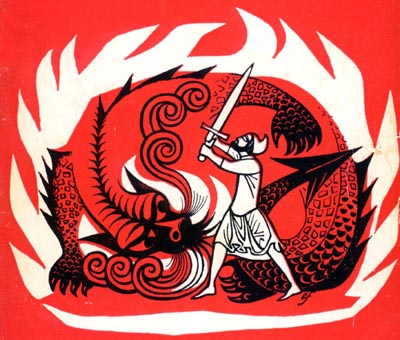 |
Back To Top
Abstract
A reflection on Beowulf's death dwells on the dragon.
Back To Top
Translation
"That which had happened was painfully felt
by the young man, when he on the ground saw
that dearest one pitiably suffering
at his life's end. The slayer also lay so,
the terrible earth dragon was bereaved of life,
by ruin overwhelmed. In the hoard of rings no
longer could the coiled serpent be on guard,
once he by sword edge was carried off,
hard, battle-sharp remnant of hammers,so
that the wide flier by wounds was still and
fallen on earth near the treasure house. Never
after did he move about through the air by flight
in the middle of the night, in his rich possession
glorying, never could he make more appearances,
since he fell to earth at the war leader's deed of the
hand."
(Beowulf ll.2821-2835)
Back To Top
Recordings
Old English:
Modern English:
Back To Top
Showing Mourning
The first question to surface here, like the hideous sea beasts pulled from Grendel's Mother's mire, is why a section of the poem that's showing Wiglaf's grief for Beowulf immediately after his death dwells so long on the dragon rather than Beowulf.
It could be that the poet/scribe went this way because so much of the rest of the poem is given over to Beowulf. Or it could be that Wiglaf's attention is simply drawn to the dragon because of the sheer spectacle of the sight. Though, it could also be that Wiglaf looks over to the dragon for the sake of contrast, to put off the reality of Beowulf's death for just a short time so that he, as all but Beowulf's named successor, can have a brief respite before he must coldly go forth and fulfil his duty as the new Geatish leader.
Of course, it could also be the poet's own voice that pulls away from Wiglaf at this point, leaving his perspective behind for a time to turn a little more omniscient, and to give us, the listers/readers a view of the dragon as it lay dead so that we can contrast it with Beowulf.
Back To Top
Seeking Meaning
Germanic culture widely held that dragons were symbols of the greed that would undermine the gift-centric Germanic society. So perhaps the focus on the dragon and the recounting of how it can no longer do anyone any harm suggests that greed itself has been defeated, and by one so noble as to sacrifice his own good for going against the advice of his counsel and fighting the dragon.
Maybe even the defeat of greed and the destruction of the Geats themselves that is an almost inevitable result (since they're now kingless and sitting on all of this gold) are related.
If this version of the poem is as Christian as some believe, then this shift over to the dragon shouldn't be read as Wiglaf's or the poet/scribe's attempt to contrast a death with a death, but instead as a way to show that the perfection of a society through the defeat of its greatest evil leaves that society at its end.
If Beowulf was ever used as a missionary tale, then this part of the poem could well be that which attempts to sooth potential converts into the belief that in becoming Christian their previous beliefs die off and they enter into something more perfect.
Or, again, their physical being ends, but just as Beowulf persisted up until he defeats his society's major evil, so too would the spirit of the assimilated society persist in its people. Plus, missionaries would probably say the new converts were all imbued with the spark of life that, in the Christian tradition, is generally regarded as a spoken thing - just as this story itself would've been at the time, even after having been written out.
Back To Top
Closing
So could this episode in the Beowulf saga be another key moment in the use of the poem as missionary propaganda, or is it just the poet/scribe's representation of Wiglaf's mourning? Leave a comment in the box to let me know your thoughts!
Next week, stanza three of "Dum Diane vitrea" will drop, and Wiglaf meets the cowardly thanes as they slink onto the scene.
Back To Top
Thursday, September 27, 2012
Beowulf's Death, and his Soul's Departure [ll.2809-2820] (Old English)
Abstract
Translation
Recordings
Ambiguity in Beowulf's Death
Beowulf Doomed?
Closing
Back To Top
Abstract
Beowulf bestows his war garb unto Wiglaf, and then gives up the ghost.
Back To Top
Translation
He did off the golden ring about his neck,
the brave hearted prince, gave it to the thane,
the young spear warrior, his gold adorned helmet,
ring and mail shirt, commanded him to use them well:
"You are the last remaining of our kin,
of the Waegmundings; fate has swept away all
of my line as per the decree of destiny,
warriors in valour; I after them now shall go."
That was the old one's last word
of thoughts of the heart before he chose the pyre,
the hot battle flame; from his breast went
his soul to seek the judgment of the righteous.
(Beowulf ll.2809-2820)
Back To Top
Recordings
Old English:
Modern English:
Back To Top
Ambiguity in Beowulf's Death
As will be the case with the death of any great literary figure, this passage is one that's often studied. Beyond its importance to the story, we're also once more confronted with some ambiguity around Beowulf's deeds. Yet, rather than being confronted with ambiguity by the words of Beowulf himself, we're confronted with ambiguity in the poet/scribe's own phrasing.
At the passage's end we're told that Beowulf's soul leaves to "seek the judgement of the righteous." Just as the phrase "judgement of the righteous" is ambiguous in Modern English, since the litigous could defend its meaning either 'the judgement handed down by the righteous,' or 'the judgement that is passed on the righteous,' it's the same in Old English. There it simply reads: "soðfæstra dom" (l.2820).
The problem here is that there's no clarifying word or phrase either in the original or in most translations that strive to be accurate. As a result we're left with something that leaves the interpretation up to the listener/reader.
But could this maybe be the point here? Could the poet/scribe who created the version of the poem that we have today have been going for ambiguity at this part of the poem?
Just as either side of the phrase's meaning could be argued, so too could either side of the interpretation debate.
In brief, if it's understood to mean that Beowulf is a righteous one going to the judgment that awaits him it sets him among the holy heathens whom Christ pulled from the upper levels of hell during its harrowing.
Alternately, if the phrase is interpreted as meaning that the righteous are passing judgment, there's a strong implication that either righteousness is something a person earns after being judged worthy by those who have it (thereby becoming one of their peers).
Or, taking this meaning could mean that Beowulf really isn't righteous at all, and that his being judged by them means that there will be a great deal of hardship in his afterlife.
Back To Top
Beowulf Doomed?
Of these three possibilities, the most interesting is that Beowulf might be doomed in the end since he's being judged by the righteous.
A truly puritanical Christian audience might be expecting as much from such a violent, alcoholic figure, but at the same time, that would seriously undermine any missionary value that this story had. After all, the Christian monks who recorded stories such as this from oral traditions would definitely have given them a spin that could be useful for bringing around the unconverted.
Of course, that gives the idea that this moment of ambiguity is intentional even more steam.
Yes, it could maybe spark debate among those who differ in their interpretations, but as long as this version was being told by a priest or religious, they would be there to point the way to their own version of the truth. If monks or religious actually went around reciting this poem, then this moment in particular would be the perfect one to serve as a crisis moment that could be turned around and explained so as to make Christ seem super appealing.
Unfortunately, the only way we'll ever know for sure if any of this speculation about the ambiguity of the phrase "soðfæstra dom" is accurate is if another version of the poem shows up or the scribe of our version is definitively identified.
Until then, feel free to leave your thoughts on the phrase in the comments!
Back To Top
Closing
Next week, the second verse of "Dum Diane vitrea" will be up, along with what Wiglaf does next after Beowulf's demise.
Back To Top
Translation
Recordings
Ambiguity in Beowulf's Death
Beowulf Doomed?
Closing
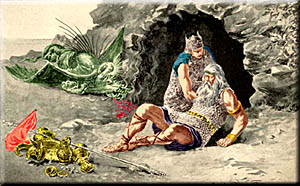 |
Back To Top
Abstract
Beowulf bestows his war garb unto Wiglaf, and then gives up the ghost.
Back To Top
Translation
He did off the golden ring about his neck,
the brave hearted prince, gave it to the thane,
the young spear warrior, his gold adorned helmet,
ring and mail shirt, commanded him to use them well:
"You are the last remaining of our kin,
of the Waegmundings; fate has swept away all
of my line as per the decree of destiny,
warriors in valour; I after them now shall go."
That was the old one's last word
of thoughts of the heart before he chose the pyre,
the hot battle flame; from his breast went
his soul to seek the judgment of the righteous.
(Beowulf ll.2809-2820)
Back To Top
Recordings
Old English:
Modern English:
Back To Top
Ambiguity in Beowulf's Death
As will be the case with the death of any great literary figure, this passage is one that's often studied. Beyond its importance to the story, we're also once more confronted with some ambiguity around Beowulf's deeds. Yet, rather than being confronted with ambiguity by the words of Beowulf himself, we're confronted with ambiguity in the poet/scribe's own phrasing.
At the passage's end we're told that Beowulf's soul leaves to "seek the judgement of the righteous." Just as the phrase "judgement of the righteous" is ambiguous in Modern English, since the litigous could defend its meaning either 'the judgement handed down by the righteous,' or 'the judgement that is passed on the righteous,' it's the same in Old English. There it simply reads: "soðfæstra dom" (l.2820).
The problem here is that there's no clarifying word or phrase either in the original or in most translations that strive to be accurate. As a result we're left with something that leaves the interpretation up to the listener/reader.
But could this maybe be the point here? Could the poet/scribe who created the version of the poem that we have today have been going for ambiguity at this part of the poem?
Just as either side of the phrase's meaning could be argued, so too could either side of the interpretation debate.
In brief, if it's understood to mean that Beowulf is a righteous one going to the judgment that awaits him it sets him among the holy heathens whom Christ pulled from the upper levels of hell during its harrowing.
Alternately, if the phrase is interpreted as meaning that the righteous are passing judgment, there's a strong implication that either righteousness is something a person earns after being judged worthy by those who have it (thereby becoming one of their peers).
Or, taking this meaning could mean that Beowulf really isn't righteous at all, and that his being judged by them means that there will be a great deal of hardship in his afterlife.
Back To Top
Beowulf Doomed?
Of these three possibilities, the most interesting is that Beowulf might be doomed in the end since he's being judged by the righteous.
A truly puritanical Christian audience might be expecting as much from such a violent, alcoholic figure, but at the same time, that would seriously undermine any missionary value that this story had. After all, the Christian monks who recorded stories such as this from oral traditions would definitely have given them a spin that could be useful for bringing around the unconverted.
Of course, that gives the idea that this moment of ambiguity is intentional even more steam.
Yes, it could maybe spark debate among those who differ in their interpretations, but as long as this version was being told by a priest or religious, they would be there to point the way to their own version of the truth. If monks or religious actually went around reciting this poem, then this moment in particular would be the perfect one to serve as a crisis moment that could be turned around and explained so as to make Christ seem super appealing.
Unfortunately, the only way we'll ever know for sure if any of this speculation about the ambiguity of the phrase "soðfæstra dom" is accurate is if another version of the poem shows up or the scribe of our version is definitively identified.
Until then, feel free to leave your thoughts on the phrase in the comments!
Back To Top
Closing
Next week, the second verse of "Dum Diane vitrea" will be up, along with what Wiglaf does next after Beowulf's demise.
Back To Top
Thursday, September 20, 2012
Translation and the Bejewelled Truth [ll.2794-2808] (Old English)
A quick note: I realize that I had planned the first entry for the poem "Dum Diane vitrea" this past Tuesday. However, since I was quite distracted by travelling to Toronto for a Peter Gabriel concert by way of Guelph, that entry was not published. Watch for it next week, and my apologies for missing a beat. I've got my rhtyhm back now, though.
So, onwards!
Abstract
Translation
Recordings
The Facets of Translation
Answering Questions Raised
Probing Possibility
Closing
Back To Top
Abstract
Beowulf gives thanks for his seeing the dragon's treasure, and gives Wiglaf instructions for his funerary arrangements.
Back To Top
Translation
"'I for all of these precious things thank the Lord,
spoke these words the king of glory,
eternal lord, that I here look in on,
for the fact that I have been permitted to gain
such for my people before my day of death.
Now that I the treasure hoard have bought
with my old life, still attend to the
need of my people; for I may not be here longer.
Command the famed in battle to build a splendid barrow
after the pyre at the promontory over the sea;
it is to be a memorial to my people
high towering on Whale's Ness,
so that seafarers may later call it
Beowulf's Barrow, those who in ships
over the sea mists come sailing from afar.'"
(Beowulf ll.2794-2808)
Back To Top
Recordings
Old English:
Modern English:
Back To Top
The Facets of Translation
The most prominent feature of this week's passage is the awkward opening sentence.
Its gist is straightfrward enough: Beowulf is thanking what we can safely guess is the Christian god for his successes, as he has done previously. However, if translating things fairly literally (perhaps too literally), we wind up with a second clause about the words being spoken by god ("wuldurcyninge wordum secge" ll.2795). Many translations omit this line since it appears to just repeat and expand upon Beowulf's thanks to god, as it could come out as "[I...]speak these words to the king of glory."
Yet, and this is where I exert a bit of extra pressure on the text, I've translated the second line as a reference to the jewels and the like being the words of god.
The reason for taking this route with the translation is simple: it gives the reader the opportunity to interpret the dragon's hoard as the words of god, as some sort of cosmological truth as spoken directly by the creator of those cosmos. Opening up this possibility forces readers to take another look at the dragon, too. It's still antagonistic in that it's keeping the words of god to itself and needs to be killed for them to be distributed, but then just what kind of entity is it?
It might stretching things to the breaking point, but it seems that the dragon could be interpreted as the powerful priesthood or any entrenched exclusionary religious group, and Beowulf could then be considered some kind of scholar, wrenching the truth from those who are in places of religious power and being ready to redistribute it. Though, as we find out later in the poem, this doesn't happen since the treasure is buried with Beowulf since the Geats consider it too dangerous to add massive wealth to their leader-less state.
Back To Top
Answering Questions Raised
In this reading of the hoard as cosmological truth, we need to consider what it means for Beowulf to die for it. One possibility is that in taking on such a major source of authority he destroys all of his own credibility, and as a result the truth that he uncovers can't be successfully transmitted since without credibility (or in more contemporary terms, authority or auctoritas) no one will willingly accept what he has to say.
That brings us around the matters of the theif and of Wiglaf. In this interpretation of the dragon's hoard as some sort of great truth, the theif could well be one who haplessly leaked one of its aspects and therefore set the whole of Beowulf's kingdom astir. A little bit of knowledge can be much more dangerous than a lot, after all.
As per Wiglaf, he could be an acolyte of the elder scholar Beowulf. He could be a youth who has joined his cause when noone else was brave enough to, and who cared enough for the tradition of truth than the institution which had grown up and kept it from the masses.
Back To Top
Probing Possibility
The last question that this interpretation needs to face is whether or not it could have been knowingly injected into a poem written down by people working for the medieval church, an institution that was rarely free from accusations of withholding knowledge or working contrarily to the truth of things. Representing the church as a dragon, something commonly equated with the devil, could be risky in a medieval context, but I argue that this interpretation of the dragon's hoard would hold up since the dragon could be explained as a symbol only for the corrupt within the Church and not necessarily the Church itself.
So, do you think that this interpretation holds water, or am I just stretching my own credibility by trying to keep my translation as literal as I can? Or, for that matter, have I missed something in my translation? Let me know in the comments!
Back To Top
Closing
Next week, the full complement of a Latin and Old English entry will return, with the first verse of "Dum Diane vitrea" and Beowulf's further final words to Wiglaf.
Back To Top
So, onwards!
Abstract
Translation
Recordings
The Facets of Translation
Answering Questions Raised
Probing Possibility
Closing
 |
Back To Top
Abstract
Beowulf gives thanks for his seeing the dragon's treasure, and gives Wiglaf instructions for his funerary arrangements.
Back To Top
Translation
"'I for all of these precious things thank the Lord,
spoke these words the king of glory,
eternal lord, that I here look in on,
for the fact that I have been permitted to gain
such for my people before my day of death.
Now that I the treasure hoard have bought
with my old life, still attend to the
need of my people; for I may not be here longer.
Command the famed in battle to build a splendid barrow
after the pyre at the promontory over the sea;
it is to be a memorial to my people
high towering on Whale's Ness,
so that seafarers may later call it
Beowulf's Barrow, those who in ships
over the sea mists come sailing from afar.'"
(Beowulf ll.2794-2808)
Back To Top
Recordings
Old English:
Modern English:
Back To Top
The Facets of Translation
The most prominent feature of this week's passage is the awkward opening sentence.
Its gist is straightfrward enough: Beowulf is thanking what we can safely guess is the Christian god for his successes, as he has done previously. However, if translating things fairly literally (perhaps too literally), we wind up with a second clause about the words being spoken by god ("wuldurcyninge wordum secge" ll.2795). Many translations omit this line since it appears to just repeat and expand upon Beowulf's thanks to god, as it could come out as "[I...]speak these words to the king of glory."
Yet, and this is where I exert a bit of extra pressure on the text, I've translated the second line as a reference to the jewels and the like being the words of god.
The reason for taking this route with the translation is simple: it gives the reader the opportunity to interpret the dragon's hoard as the words of god, as some sort of cosmological truth as spoken directly by the creator of those cosmos. Opening up this possibility forces readers to take another look at the dragon, too. It's still antagonistic in that it's keeping the words of god to itself and needs to be killed for them to be distributed, but then just what kind of entity is it?
It might stretching things to the breaking point, but it seems that the dragon could be interpreted as the powerful priesthood or any entrenched exclusionary religious group, and Beowulf could then be considered some kind of scholar, wrenching the truth from those who are in places of religious power and being ready to redistribute it. Though, as we find out later in the poem, this doesn't happen since the treasure is buried with Beowulf since the Geats consider it too dangerous to add massive wealth to their leader-less state.
Back To Top
Answering Questions Raised
In this reading of the hoard as cosmological truth, we need to consider what it means for Beowulf to die for it. One possibility is that in taking on such a major source of authority he destroys all of his own credibility, and as a result the truth that he uncovers can't be successfully transmitted since without credibility (or in more contemporary terms, authority or auctoritas) no one will willingly accept what he has to say.
That brings us around the matters of the theif and of Wiglaf. In this interpretation of the dragon's hoard as some sort of great truth, the theif could well be one who haplessly leaked one of its aspects and therefore set the whole of Beowulf's kingdom astir. A little bit of knowledge can be much more dangerous than a lot, after all.
As per Wiglaf, he could be an acolyte of the elder scholar Beowulf. He could be a youth who has joined his cause when noone else was brave enough to, and who cared enough for the tradition of truth than the institution which had grown up and kept it from the masses.
Back To Top
Probing Possibility
The last question that this interpretation needs to face is whether or not it could have been knowingly injected into a poem written down by people working for the medieval church, an institution that was rarely free from accusations of withholding knowledge or working contrarily to the truth of things. Representing the church as a dragon, something commonly equated with the devil, could be risky in a medieval context, but I argue that this interpretation of the dragon's hoard would hold up since the dragon could be explained as a symbol only for the corrupt within the Church and not necessarily the Church itself.
So, do you think that this interpretation holds water, or am I just stretching my own credibility by trying to keep my translation as literal as I can? Or, for that matter, have I missed something in my translation? Let me know in the comments!
Back To Top
Closing
Next week, the full complement of a Latin and Old English entry will return, with the first verse of "Dum Diane vitrea" and Beowulf's further final words to Wiglaf.
Back To Top
Thursday, September 13, 2012
On Wiglaf's Rushing Back [ll.2783-2793] (Old English)
Abstract
Translation
Recordings
Loyal Wiglaf
As Beowulf Lay Bleeding
Closing
Back To Top
Abstract
Wiglaf remains nameless, as he rushes back to show Beowulf the gold from the hoard.
Back To Top
Translation
"The messenger was in haste, eager in the journey back
By precious things he was urged on; anxiety oppressed him,
whether he would meet bold in spirit and alive
in that place the prince of the Weders,
deprived of strength, where he had earlier left him.
He then with the treasure the renowned prince,
his lord bleeding, found,
his life at an end; he then again began the
sprinkling of water, until the beginning of words
broke through his heart. The warrior king spoke,
old in sorrow - looked at the gold:"
(Beowulf ll.2783-2793)
Back To Top
Recordings
Old English:
Modern English:
Back To Top
Loyal Wiglaf
There's a lot about loyalty in this passage. Wiglaf's rushing back with gold in tow to show Beowulf, as per his final request, really highlights it.
In fact, that's really all we're treated to here, which is quite remarkable given all of the information we've been given in previous passages of the same length. When Wiglaf is in the hoard, the treasure is described and listed, when he and Beowulf are fighting the dragon, almost every lines shows us their manoeuvre or the dragon's. But here, we just have Wiglaf rushing to show Beowulf the treasure.
It's quite a distinct split from what's come before. But it's also a great way to signal that the big shift from being primarily about Beowulf to being about his death and the future of the Geats is finally about to come.
Back To Top
As Beowulf Lay Bleeding
One word in particular stands out, though. When Wiglaf returns to Beowulf we're immediately told that he's found bleeding ("driorigne" l.2789). To note this with this word in particular is strange, since it suggests that before he left for the hoard Beowulf's wound had somehow stopped bleeding, been stopped bleeding, or Wiglaf expected it to stop before he got back.
Regardless of what the case may be with the wound itself, that we're given this detail really drives home the fact that this is it for Beowulf. Just as he is found bleeding his very life away, so too will the words that he next speaks be his last, as he releases the last of those two - effectively closing the word hoard.
Curiously, I imagine that his body will continue to bleed beyond his actual time of death, which, though maybe not apparent to a listening audience, acknowledges an idea that words are themselves a kind of adornment for life, something that can be woven and worn over something more plain like a brooch binding the collar of a simple cloak.
At the same time, Beowulf doesn't mention anything about grand words that he's spoken in the past when he tells Wiglaf that he has joy in his wound, but rather the hero says this because he has done nothing to incriminate himself. Perhaps then, even a listening audience would notice the warp and woof of the scop's words as he sang the song of Beowulf.
Back To Top
Closing
Next week, Old English will return, but the return of Latin is still uncertain.
Back To Top
Translation
Recordings
Loyal Wiglaf
As Beowulf Lay Bleeding
Closing
Back To Top
Abstract
Wiglaf remains nameless, as he rushes back to show Beowulf the gold from the hoard.
Back To Top
Translation
"The messenger was in haste, eager in the journey back
By precious things he was urged on; anxiety oppressed him,
whether he would meet bold in spirit and alive
in that place the prince of the Weders,
deprived of strength, where he had earlier left him.
He then with the treasure the renowned prince,
his lord bleeding, found,
his life at an end; he then again began the
sprinkling of water, until the beginning of words
broke through his heart. The warrior king spoke,
old in sorrow - looked at the gold:"
(Beowulf ll.2783-2793)
Back To Top
Recordings
Old English:
Modern English:
Back To Top
Loyal Wiglaf
There's a lot about loyalty in this passage. Wiglaf's rushing back with gold in tow to show Beowulf, as per his final request, really highlights it.
In fact, that's really all we're treated to here, which is quite remarkable given all of the information we've been given in previous passages of the same length. When Wiglaf is in the hoard, the treasure is described and listed, when he and Beowulf are fighting the dragon, almost every lines shows us their manoeuvre or the dragon's. But here, we just have Wiglaf rushing to show Beowulf the treasure.
It's quite a distinct split from what's come before. But it's also a great way to signal that the big shift from being primarily about Beowulf to being about his death and the future of the Geats is finally about to come.
Back To Top
As Beowulf Lay Bleeding
One word in particular stands out, though. When Wiglaf returns to Beowulf we're immediately told that he's found bleeding ("driorigne" l.2789). To note this with this word in particular is strange, since it suggests that before he left for the hoard Beowulf's wound had somehow stopped bleeding, been stopped bleeding, or Wiglaf expected it to stop before he got back.
Regardless of what the case may be with the wound itself, that we're given this detail really drives home the fact that this is it for Beowulf. Just as he is found bleeding his very life away, so too will the words that he next speaks be his last, as he releases the last of those two - effectively closing the word hoard.
Curiously, I imagine that his body will continue to bleed beyond his actual time of death, which, though maybe not apparent to a listening audience, acknowledges an idea that words are themselves a kind of adornment for life, something that can be woven and worn over something more plain like a brooch binding the collar of a simple cloak.
At the same time, Beowulf doesn't mention anything about grand words that he's spoken in the past when he tells Wiglaf that he has joy in his wound, but rather the hero says this because he has done nothing to incriminate himself. Perhaps then, even a listening audience would notice the warp and woof of the scop's words as he sang the song of Beowulf.
Back To Top
Closing
Next week, Old English will return, but the return of Latin is still uncertain.
Back To Top
Thursday, August 16, 2012
The Emptiness of All that Gold [ll.2771b-82] (Old English)
Abstract
Translation
Recordings
The Hoard's Sheer Immensity
The Golden Power
Closing
Back To Top
Abstract
The dragon is dwelled on, while Wiglaf wanders through the hoard.
Back To Top
Translation
"None of that sight there
was for the serpent, when the blade carried him off.
Then, I have heard, the hoard in the barrow, ancient
work of giants, was ransacked by one man, he loaded
his lap with drinking vessels and dishes of his own
choosing, the standard he also took, brightest of banners.
The sword earlier had injured - the blade was iron - that
of the aged lord, that was the treasure's guardian for
a long time, terrifying fire brought
hot from the hoard, fiercely willing in
the middle of the night, until he a violent death died."
(Beowulf ll.2771b-82)
Back To Top
Recordings
Old English:
{Forthcoming}
Modern English:
{Forthcoming}
Back To Top
The Hoard's Sheer Immensity
Already it's been mentioned how Wiglaf is not referred to by name for some time after this point, but here the poet/scribe takes this lack of identity to a strange place.
Instead of referring to Wiglaf via synecdoche with a piece of a warrior's equipment, or calling him a "thane" or "fighter," the poet/scribe simply calls Wiglaf "one man" ("ānne mannan" (l.2774)).
The effect of this pronoun and its adjective is immense.
However, this immensity doesn't come from the alienation that the poet/scribe subjects Wiglaf to, but rather from the sheer size of the hoard that the poet/scribe's making Wiglaf suddenly so small implies. Don't forget that because of that shining banner everything is now illuminated, so we can liken this part of the poem to a long panning shot that might be used in movies to show a suddenly-broken-into, vast treasure chamber in an ancient temple or tomb.
Yet, it's curious that the poet/scribe describes the immensity of the hoard in this way, especially since there's so much build up to it.
We hear about it when the thief stumbles into it (ll.2283-4), again when Beowulf and his thanes head to the barrow (ll.2412-3), and then again in Beowulf's command to Wiglaf (ll.2745-6).
Plus, any Anglo-Saxon would have been practically salivating at the prospect of finding so much treasure all in one spot - becoming instantly wealthy and instantaneously being able to exercise huge influence over others through gifts, thereby shoring up his or her own reputation and social network so that they would be more secure than gold alone would allow.
Back To Top
The Golden Power
In fact, it's exactly within the gold-giving culture of the Anglo Saxons that we can find another reason for the poet/scribe's describing the hoard as he does.
Rather than focus on how much there is, the poet/scribe has described the hoard through a kind of lack. It's big and immense, but it's the sort of thing that you can lose yourself in - even if you're a loyal thane who's already pledged your very being to help your lord in his dying moments.
And this is what makes the dragon's hoard so dreadful. It's big, it's vast, it's unwieldy.
No one could use that much gold for social reasons, and the temptation to fall into self-indulgence (as Heremod does in the story Hrothgar tells Beowulf (ll.1709-1722)) is practically irresistible. If there is a curse on the gold, that is the curse: to be instantly given so much that you don't know what to do with yourself so you revert to an animalistic state.
Some have even theorized that the survivor who sings the "Lay of the Last Survivor" (ll.2247–66) somehow became the dragon: The last of his kind pining away over the treasure that could not buy back the lives of his fallen people or return them to their former glory.
This might also explain why the dragon is so prominently featured in this passage, despite his being long since dead. As Beowulf's wishes have taken over Wiglaf's identity, now the dragon's identity, the miserly lord of plenty, threatens to do the same. Yet ultimately Wiglaf resists, for the poet/scribe sings that the dragon "a violent death died" ("hē morðre swealt" (l.2782)) to round out Wiglaf's time in the hoard.
Back To Top
Closing
Next week, this blog will be on break. I've fallen too far behind in the recordings to keep heading onwards and since I finished "O Fortuna" this week, I want to give myself time to catch up before moving onto my next Latin text.
In the meantime be sure to check my past entries and recordings, and if you like what you read and hear, feel free to support my efforts here!
Back To Top
Translation
Recordings
The Hoard's Sheer Immensity
The Golden Power
Closing
 |
Back To Top
Abstract
The dragon is dwelled on, while Wiglaf wanders through the hoard.
Back To Top
Translation
"None of that sight there
was for the serpent, when the blade carried him off.
Then, I have heard, the hoard in the barrow, ancient
work of giants, was ransacked by one man, he loaded
his lap with drinking vessels and dishes of his own
choosing, the standard he also took, brightest of banners.
The sword earlier had injured - the blade was iron - that
of the aged lord, that was the treasure's guardian for
a long time, terrifying fire brought
hot from the hoard, fiercely willing in
the middle of the night, until he a violent death died."
(Beowulf ll.2771b-82)
Back To Top
Recordings
Old English:
{Forthcoming}
Modern English:
{Forthcoming}
Back To Top
The Hoard's Sheer Immensity
Already it's been mentioned how Wiglaf is not referred to by name for some time after this point, but here the poet/scribe takes this lack of identity to a strange place.
Instead of referring to Wiglaf via synecdoche with a piece of a warrior's equipment, or calling him a "thane" or "fighter," the poet/scribe simply calls Wiglaf "one man" ("ānne mannan" (l.2774)).
The effect of this pronoun and its adjective is immense.
However, this immensity doesn't come from the alienation that the poet/scribe subjects Wiglaf to, but rather from the sheer size of the hoard that the poet/scribe's making Wiglaf suddenly so small implies. Don't forget that because of that shining banner everything is now illuminated, so we can liken this part of the poem to a long panning shot that might be used in movies to show a suddenly-broken-into, vast treasure chamber in an ancient temple or tomb.
Yet, it's curious that the poet/scribe describes the immensity of the hoard in this way, especially since there's so much build up to it.
We hear about it when the thief stumbles into it (ll.2283-4), again when Beowulf and his thanes head to the barrow (ll.2412-3), and then again in Beowulf's command to Wiglaf (ll.2745-6).
Plus, any Anglo-Saxon would have been practically salivating at the prospect of finding so much treasure all in one spot - becoming instantly wealthy and instantaneously being able to exercise huge influence over others through gifts, thereby shoring up his or her own reputation and social network so that they would be more secure than gold alone would allow.
Back To Top
The Golden Power
In fact, it's exactly within the gold-giving culture of the Anglo Saxons that we can find another reason for the poet/scribe's describing the hoard as he does.
Rather than focus on how much there is, the poet/scribe has described the hoard through a kind of lack. It's big and immense, but it's the sort of thing that you can lose yourself in - even if you're a loyal thane who's already pledged your very being to help your lord in his dying moments.
And this is what makes the dragon's hoard so dreadful. It's big, it's vast, it's unwieldy.
No one could use that much gold for social reasons, and the temptation to fall into self-indulgence (as Heremod does in the story Hrothgar tells Beowulf (ll.1709-1722)) is practically irresistible. If there is a curse on the gold, that is the curse: to be instantly given so much that you don't know what to do with yourself so you revert to an animalistic state.
Some have even theorized that the survivor who sings the "Lay of the Last Survivor" (ll.2247–66) somehow became the dragon: The last of his kind pining away over the treasure that could not buy back the lives of his fallen people or return them to their former glory.
This might also explain why the dragon is so prominently featured in this passage, despite his being long since dead. As Beowulf's wishes have taken over Wiglaf's identity, now the dragon's identity, the miserly lord of plenty, threatens to do the same. Yet ultimately Wiglaf resists, for the poet/scribe sings that the dragon "a violent death died" ("hē morðre swealt" (l.2782)) to round out Wiglaf's time in the hoard.
Back To Top
Closing
Next week, this blog will be on break. I've fallen too far behind in the recordings to keep heading onwards and since I finished "O Fortuna" this week, I want to give myself time to catch up before moving onto my next Latin text.
In the meantime be sure to check my past entries and recordings, and if you like what you read and hear, feel free to support my efforts here!
Back To Top
Thursday, August 9, 2012
Treasuring Words and Admiring Their Weave [ll.2756-2771a] (Old English)
Abstract
Translation
Recordings
Finding Use for Treasure
A Shining Standard
Closing
Back To Top
Abstract
Wiglaf hurries to the hoard, where he is mesmerized by the treasure that he finds.
Back To Top
Translation
"He, the triumphant in victory, when he beyond the seat
went, the young brave thane, saw many precious jewels,
glittering gold lay on the ground,
wondrous objects on the wall, and in that dragon’s lair,
daybreak flier of old, cups stood,
vessels of men of old, now lacking a burnisher,
deprived of adornment.* There were many a helmet,
old and rusty, a multitude of arm-rings
skillfully twisted. Treasure easily may,
gold in ground, overpower each one of
mankind, though one may hide it.
Also hanging he saw a standard all of gold
high over the hoard, greatest of marvels made by hand,
woven by skill of craft; from there light
shone out, so that he might see the surface of the floor,
could look at every part of those ornate objects."
(Beowulf ll.2756-2771a)
Back To Top
Recordings
Old English:
{Forthcoming}
Modern English:
{Forthcoming}
Back To Top
Finding Use for Treasure
After the excitement of the battle with the dragon, and Beowulf's heartfelt summary of his kingship, this passage is definitely something of a rest. But that doesn't mean that it's entirely silent, a point in the story where the poem's original audiences could entirely rest.
For there is treasure about.
And, along with the treasure comes a very interesting passage: "cups stood,/vessels of men of old,now lacking a burnisher,/deprived of adornment" ("orcas stondan,/fyrnmanna fatu feormendlease,/hyrstum behrorene" (ll.2760-2762)).
What makes this passage more than what it seems is it's implication about treasure and people's relationship to it. Because "deprived of adornment" follows "now lacking a burnisher" it sounds as if the burnishing, the polishing, was these cups' adornment. This makes sense since whatever precious metal they were made of would require maintenance of some sort to keep its shine.
But what's more is that as this treasure was in the care of a characteristically miserly dragon, it didn't receive that care that people would have given it. But add to this why people would care to preserve their treasure, especially the sorts of things described here. My own theory is that they would use these things and they would need them to be in their top shape.
Putting this all together you come out with the impression that the passage implies that treasure is ostensibly valuable only when it's being used by people. And treasure can't be used by the same person indefinitely, so the best way to keep treasure in use is to give it away. It's given away to be used by the young, who can then maintain it and then give it away again, thus keeping the cycle going indefinitely.
Not to mention keeping the preciousness of the treasure in tact indefinitely.
However, this reading of treasure as the fuel in a perpetual motion machine of gifting and receiving is troubled by what happens to the treasure hoard that Beowulf and Wiglaf won. It all gets buried with Beowulf.
To be fair, the treasure may well have been buried for a strategic purpose. After all, having great wealth would likely bring down the Geats' old enemies upon them much more quickly than the news of their loss alone.
Back To Top
A Shining Standard
Another illuminating part of this passage comes at it's end. The standard that lights the cave in which Wiglaf finds the hoard is clearly very shiny (being described as "all of gold" ("eallgylden" (ll.2767))), and must have sunlight striking it. But this sparkling standard is also significant because it echoes an earlier light in a cave: That which appears when Beowulf kills Grendel's Mother in her den (ll.1570-1572).
Because of the parallels - the light appears in a cave, comes from a fantastical source, flares up only after the defeat of a powerful monster of one sort or other - it's tempting to say that Wiglaf's assist in slaying the dragon is his own killing of Grendel's Mother. This reading is also bolstered by Wiglaf's taking treasures back with him to Beowulf just as Beowulf bore the hilt of the giants' sword and Grendel's head back to Hrothgar.
Yet, then, we run into the question: Is that where the parallels end? After the treasure is brought back to Beowulf and Wiglaf is cemented as the new leader of the Geats is he not still on the same trajectory as Beowulf?
Maybe he is, but because he isn't Beowulf (even if he is, for now, nameless) it's not his fate for a similar trajectory to land him in the same place as the poem's lead character.
Back To Top
Closing
Next week, the third and final stanza of "O Fortuna" gets translated (and the whole thing gets posted as a recording), and Wiglaf takes as much treasure as he can back to the waiting Beowulf.
Back To Top
Translation
Recordings
Finding Use for Treasure
A Shining Standard
Closing
 |

Back To Top
Abstract
Wiglaf hurries to the hoard, where he is mesmerized by the treasure that he finds.
Back To Top
Translation
"He, the triumphant in victory, when he beyond the seat
went, the young brave thane, saw many precious jewels,
glittering gold lay on the ground,
wondrous objects on the wall, and in that dragon’s lair,
daybreak flier of old, cups stood,
vessels of men of old, now lacking a burnisher,
deprived of adornment.* There were many a helmet,
old and rusty, a multitude of arm-rings
skillfully twisted. Treasure easily may,
gold in ground, overpower each one of
mankind, though one may hide it.
Also hanging he saw a standard all of gold
high over the hoard, greatest of marvels made by hand,
woven by skill of craft; from there light
shone out, so that he might see the surface of the floor,
could look at every part of those ornate objects."
(Beowulf ll.2756-2771a)
Back To Top
Recordings
Old English:
{Forthcoming}
Modern English:
{Forthcoming}
Back To Top
Finding Use for Treasure
After the excitement of the battle with the dragon, and Beowulf's heartfelt summary of his kingship, this passage is definitely something of a rest. But that doesn't mean that it's entirely silent, a point in the story where the poem's original audiences could entirely rest.
For there is treasure about.
And, along with the treasure comes a very interesting passage: "cups stood,/vessels of men of old,now lacking a burnisher,/deprived of adornment" ("orcas stondan,/fyrnmanna fatu feormendlease,/hyrstum behrorene" (ll.2760-2762)).
What makes this passage more than what it seems is it's implication about treasure and people's relationship to it. Because "deprived of adornment" follows "now lacking a burnisher" it sounds as if the burnishing, the polishing, was these cups' adornment. This makes sense since whatever precious metal they were made of would require maintenance of some sort to keep its shine.
But what's more is that as this treasure was in the care of a characteristically miserly dragon, it didn't receive that care that people would have given it. But add to this why people would care to preserve their treasure, especially the sorts of things described here. My own theory is that they would use these things and they would need them to be in their top shape.
Putting this all together you come out with the impression that the passage implies that treasure is ostensibly valuable only when it's being used by people. And treasure can't be used by the same person indefinitely, so the best way to keep treasure in use is to give it away. It's given away to be used by the young, who can then maintain it and then give it away again, thus keeping the cycle going indefinitely.
Not to mention keeping the preciousness of the treasure in tact indefinitely.
However, this reading of treasure as the fuel in a perpetual motion machine of gifting and receiving is troubled by what happens to the treasure hoard that Beowulf and Wiglaf won. It all gets buried with Beowulf.
To be fair, the treasure may well have been buried for a strategic purpose. After all, having great wealth would likely bring down the Geats' old enemies upon them much more quickly than the news of their loss alone.
Back To Top
A Shining Standard
Another illuminating part of this passage comes at it's end. The standard that lights the cave in which Wiglaf finds the hoard is clearly very shiny (being described as "all of gold" ("eallgylden" (ll.2767))), and must have sunlight striking it. But this sparkling standard is also significant because it echoes an earlier light in a cave: That which appears when Beowulf kills Grendel's Mother in her den (ll.1570-1572).
Because of the parallels - the light appears in a cave, comes from a fantastical source, flares up only after the defeat of a powerful monster of one sort or other - it's tempting to say that Wiglaf's assist in slaying the dragon is his own killing of Grendel's Mother. This reading is also bolstered by Wiglaf's taking treasures back with him to Beowulf just as Beowulf bore the hilt of the giants' sword and Grendel's head back to Hrothgar.
Yet, then, we run into the question: Is that where the parallels end? After the treasure is brought back to Beowulf and Wiglaf is cemented as the new leader of the Geats is he not still on the same trajectory as Beowulf?
Maybe he is, but because he isn't Beowulf (even if he is, for now, nameless) it's not his fate for a similar trajectory to land him in the same place as the poem's lead character.
Back To Top
Closing
Next week, the third and final stanza of "O Fortuna" gets translated (and the whole thing gets posted as a recording), and Wiglaf takes as much treasure as he can back to the waiting Beowulf.
Back To Top
Subscribe to:
Posts (Atom)